Licorice has a ceiling
Almost nothing in a spice drawer comes with a daily limit. Licorice does. It is 100 milligrams, it covers everything you eat in a day, and a single litre of some licorice teas can carry four times that.
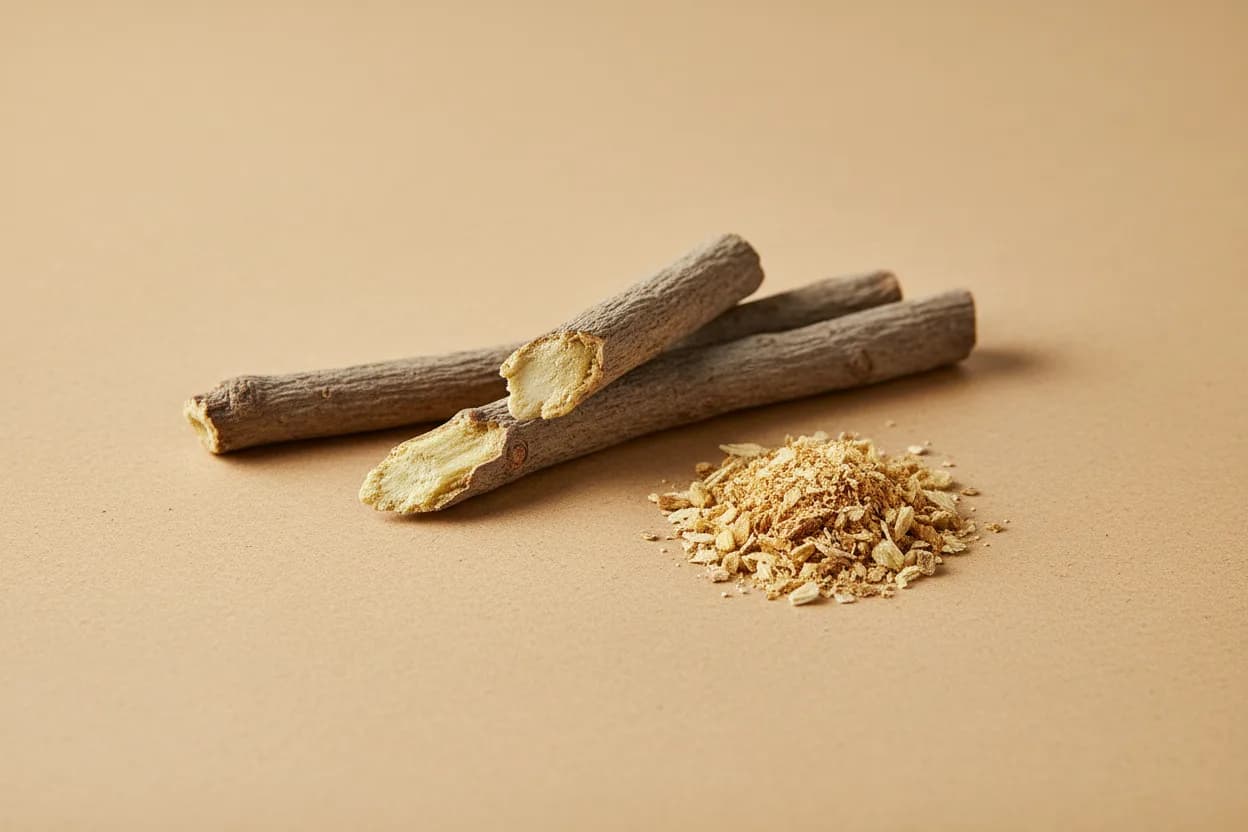
Almost nothing in a kitchen comes with a dose limit. You can put as much cumin in a pan as you can stand, and the only consequence is that it tastes of cumin. Licorice root is the rare exception in a tea cupboard: a botanical that regulators have actually put a number on, and the number is smaller than almost anyone who drinks it would guess.
This is not a scare piece. Licorice is a genuinely useful thing to have in a blend, which is why it turns up in three of the teas on this site: it is sweet without sugar, it rounds off bitterness, and it gives a thin infusion body. But a site that puts licorice in its recipes and stays quiet about the ceiling is not being straight with you.
The name is a chemical description
Glycyrrhiza glabra is a legume, a relative of peas and beans, and its Greek name is simply what it tastes like: glykys, sweet, and rhiza, root. That became glykyrrhiza, then the Latin liquiritia, then Old French licorece, and finally licorice. Dioscorides gave it a full entry in the first century, noting it grew in Cappadocia and Pontus. 3 The word has survived roughly two and a half thousand years of transmission intact, which tends to happen to plants people keep wanting.
The molecule is not sugar
The sweetness comes from glycyrrhizin, also called glycyrrhizic acid, and it is nothing like sucrose. Its formula is C₄₂H₆₂O₁₆ and it weighs 822.94, roughly two and a half times a molecule of table sugar. 2 1 Structurally it is a triterpenoid saponin: a five-ring steroid-like skeleton called glycyrrhetinic acid with two glucuronic acid sugars hung off it. The European Commission's technical dossier puts its sweetness at 33 to 200 times sucrose depending on the measurement. 1 That enormous range is itself informative. Licorice sweetness arrives late and leaves slowly, so it does not sit neatly on the same scale as sugar.
The important part is what happens after you swallow it. Glycyrrhizin is barely absorbed as it is. Gut bacteria strip the two sugars off, leaving glycyrrhetinic acid, and that is absorbed almost completely, then recycled through the liver and back into the gut, which keeps it circulating longer than you would expect. 1 The compound doing the work in your body is not quite the compound in the root.
A case of mistaken identity
Here is the mechanism, and it is one of the most elegant pieces of accidental pharmacology in the food world.
Your kidney has receptors for aldosterone, the hormone that tells it to hold on to sodium and dump potassium. The awkward fact is that cortisol, your stress hormone, binds that same receptor just as tightly, and your body carries far more cortisol than aldosterone. If nothing intervened, cortisol would drown out the signal entirely.
Something does intervene. An enzyme called 11-beta-hydroxysteroid dehydrogenase type 2 sits in those tissues and converts cortisol into inert cortisone before it can reach the receptor. It is a bouncer on a door, and its whole job is to let aldosterone through and turn cortisol away. Jim Funder and colleagues put this plainly in 1988: the specificity of the receptor is enzyme-mediated, not receptor-mediated. 5
Glycyrrhetinic acid inhibits that enzyme. Patrick Stewart, Christopher Edwards and colleagues worked this out and published it in 1987, and the title says it: liquorice produces a mineralocorticoid effect by inducing a deficiency of that enzyme. 4 With the bouncer disabled, cortisol walks in and impersonates aldosterone. You retain sodium and water, you lose potassium, your blood pressure rises, and your own aldosterone and renin fall away because the body thinks it already has plenty.
The clinical name for this is apparent mineralocorticoid excess, and the word apparent is doing precise work. Nothing is wrong with the hormone. Something is wrong with the doorman.
What that looks like in a person
Low potassium is the first thing that shows up, and it is the dangerous one, because potassium is what keeps a heart's electrical rhythm orderly. The published consequences run from muscle weakness and high blood pressure through to breakdown of skeletal muscle, arrhythmia and kidney failure. 1
The New England Journal of Medicine published a case in 2020 that is worth knowing about precisely because it is so ordinary. A 54-year-old man in Massachusetts switched from fruit-flavoured candy to black licorice, ate one to two large bags a day for about three weeks, and collapsed in cardiac arrest in a fast-food restaurant. He did not survive. 6 There was no supplement involved and no exotic extract. He ate sweets.
That is the extreme end, and it should be read as such. The more representative reports are milder and more instructive: a 74-year-old woman admitted with a potassium of 2.4 millimoles per litre, against a normal floor near 3.5, after licorice on top of a medication that pushed the same direction. 7 European case reports describe men in their forties arriving with blood pressure over 200 systolic from around 50 grams of licorice confectionery a day, an amount they would have described as a sweet tooth rather than an overdose. 1
The number, and why a tea drinker specifically should know it
The European Commission's Scientific Committee on Food looked at this in 1991, then looked again in 2003 with a decade of additional human data, and arrived back at the same figure it had started with. It could not derive a proper acceptable daily intake at all, because the human studies were too small and too short to support one. What it offered instead was a ceiling. 1
This upper limit for regular ingestion of 100 mg/day provides a sufficient level of protection for the majority of the population.
Two things about that sentence deserve attention. The first is majority, which is an admission that some people will not be protected by it. The second is that the limit explicitly covers glycyrrhizinic acid from every source combined, not per product. Sweets, tea and flavoured drinks all draw on the same daily allowance. 1
Now the figure that made me want to write this. In the same dossier, a Dutch survey of 33 herbal tea brands measured glycyrrhizinic acid in the prepared drink. Most were modest. Four exceeded 100 milligrams per litre, and the highest came in at 450. 1 A litre is not an unusual amount of tea for someone who likes it. One pot of the strongest brand tested carries four and a half times the daily ceiling, on its own, before any candy.
This is the practical point of the whole note. Licorice in a cup is fine. Licorice as your default all-day drink, brewed strong, for weeks, is a different proposition, and the difference is not visible or tasteable. Nothing warns you.
Who should be more careful than that
The committee names the groups whose margin is thinner: people with high blood pressure, anyone with a condition affecting electrolyte or water balance, people with slow gut transit (which extends the compound's stay), and people whose version of that enzyme is naturally less active. 1 Add anyone on diuretics or corticosteroids, which push potassium the same way.
Pregnancy deserves its own line, because the same enzyme does a second job there: in the placenta it shields the fetus from the mother's much higher cortisol. A Finnish cohort followed children whose mothers had consumed large amounts of licorice while pregnant and reported differences in pubertal timing, cognitive test scores and psychiatric symptoms years later. 8 Cohort studies show association rather than cause, and this is one research group's line of work rather than a settled literature, so hold it lightly. But the mechanism is plausible and specific, which is more than most dietary scares can claim.
On the other side of the ledger, the honest summary of licorice as medicine is thin. The US National Center for Complementary and Integrative Health puts it about as plainly as an agency can: there is not enough high-quality evidence to clearly support licorice root for any health condition. 9 The old trials of deglycyrrhizinated licorice for ulcers, the version with the problematic molecule stripped out, date mostly from the 1970s and are mixed.
One last thing you probably have backwards
Most black licorice candy sold in the United States contains no licorice. The flavour comes from anise oil, whose active compound is anethole, from a plant in the carrot family with no relation to Glycyrrhiza at all. It is the same molecule that makes star anise and fennel taste the way they do. So a great many people who are certain they hate licorice have never met it, and a great many who eat it constantly are eating a completely different plant. The tell is the ingredient list: licorice extract is licorice, anise oil is not.
Which leaves the actual advice, and it is unglamorous. Keep licorice as a component rather than a base. Rotate your tea. If you are pregnant, on blood pressure medication, or drinking the same strong licorice blend every day for months, that is the case worth mentioning to a doctor, not because the root is dangerous but because it is pharmacologically active, which is a different and more interesting thing. It is one of the very few things in the cupboard that is genuinely doing something, and the price of that is a number.
Sources
Every numbered claim above points here. Links go to the paper, record, or authority itself.
- 1.
European Commission, Scientific Committee on Food. Opinion of the Scientific Committee on Food on Glycyrrhizinic Acid and its Ammonium Salt. SCF/CS/ADD/EDUL/225 Final, adopted 10 April 2003.
https://ec.europa.eu/food/fs/sc/scf/out186_en.pdf - 2.
PubChem Compound Summary CID 14982, Glycyrrhizin (glycyrrhizic acid). National Center for Biotechnology Information.
https://pubchem.ncbi.nlm.nih.gov/compound/14982 - 3.
Fiore C, Eisenhut M, Ragazzi E, Zanchin G, Armanini D. A history of the therapeutic use of liquorice in Europe. Journal of Ethnopharmacology. 2005;99(3):317-324.
https://doi.org/10.1016/j.jep.2005.04.015 - 4.
Stewart PM, Wallace AM, Valentino R, Burt D, Shackleton CHL, Edwards CRW. Mineralocorticoid activity of liquorice: 11-beta-hydroxysteroid dehydrogenase deficiency comes of age. The Lancet. 1987;330(8563):821-824. PMID 2889032.
https://pubmed.ncbi.nlm.nih.gov/2889032/ - 5.
Funder JW, Pearce PT, Smith R, Smith AI. Mineralocorticoid action: target tissue specificity is enzyme, not receptor, mediated. Science. 1988;242(4878):583-585. PMID 2845584.
https://pubmed.ncbi.nlm.nih.gov/2845584/ - 6.
Edelman ER, Butala NM, Avery LL, Lundquist AL, Dighe AS. Case 30-2020: A 54-Year-Old Man with Sudden Cardiac Arrest. New England Journal of Medicine. 2020;383(13):1263-1275.
https://doi.org/10.1056/NEJMcpc2002420 - 7.
Benge E, Shah P, Yamaguchi L, Josef V. Trick or Treat? Licorice-Induced Hypokalemia: A Case Report. Cureus. 2020;12(11):e11656.
https://doi.org/10.7759/cureus.11656 - 8.
Räikkönen K, Martikainen S, Pesonen AK, et al. Maternal Licorice Consumption During Pregnancy and Pubertal, Cognitive, and Psychiatric Outcomes in Children. American Journal of Epidemiology. 2017;185(5):317-328.
https://doi.org/10.1093/aje/kww172 - 9.
National Center for Complementary and Integrative Health (US National Institutes of Health). Licorice Root: Usefulness and Safety.
https://www.nccih.nih.gov/health/licorice-root