The smell you think is in your mouth
Pinch your nose, bite a strawberry, and the strawberry goes away. What is left is sweet and slightly sour, and that is all your tongue was ever contributing. The rest was smell, arriving at your nose from inside your mouth. The famous number attached to this, that 80 per cent of taste is really smell, turns out to descend from six people tasting one ester in sugar water in 1977.
Contents
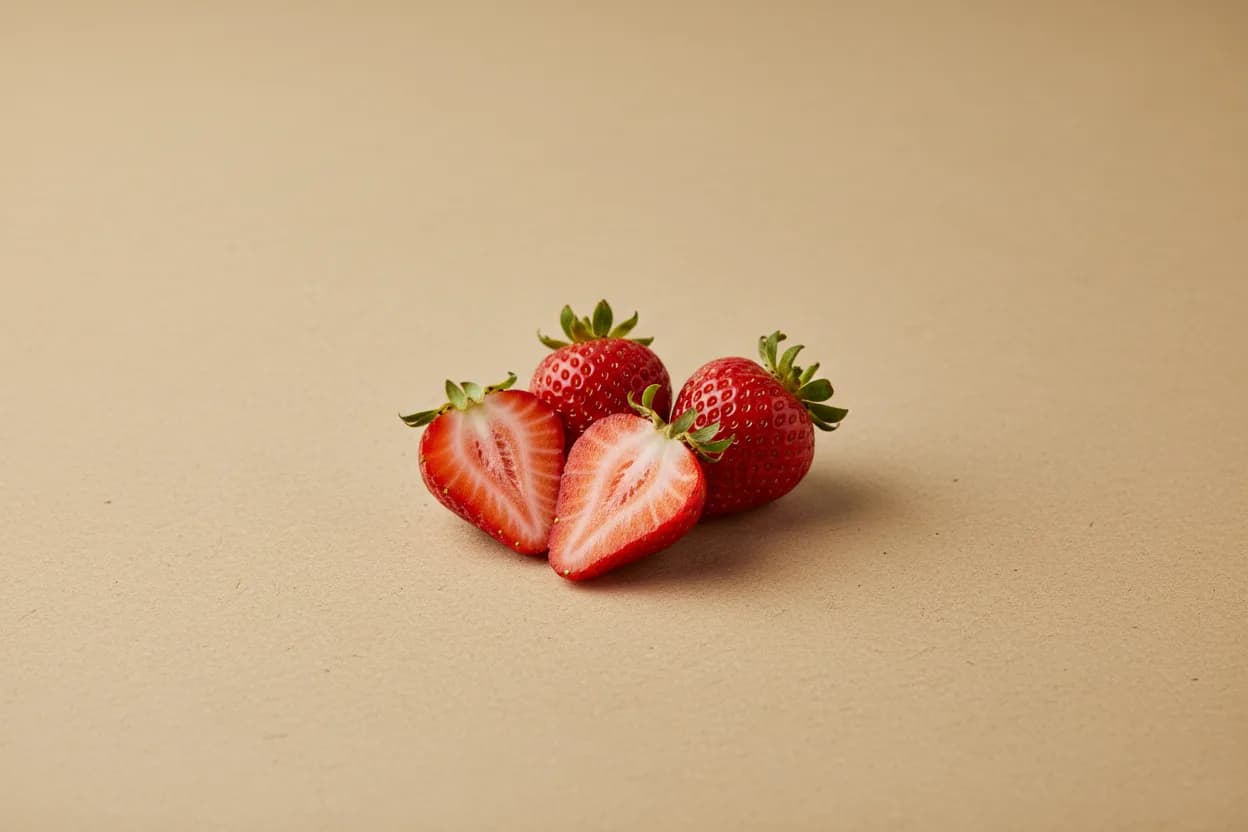
Pinch your nose shut and bite a strawberry. Chew it properly, with your nostrils held closed, and pay attention to what survives. Sweet, a little sour, wet, cold, some seeds. What is gone is the strawberry. Then let go of your nose, and while the pulp is still in your mouth, the whole fruit floods back in a single beat.
Nothing changed in your mouth during that experiment. The receptors that produce the strawberry are in a patch of tissue high in your nasal cavity, behind the bridge of your nose, and the volatile molecules reach them from inside your mouth, travelling up and back through the passage behind your soft palate. Smelling that way, from the mouth outward, is called retronasal olfaction, and it is doing most of the work you have been crediting to your tongue.
In-mouth and out-there
The person who made the case that these are two different senses was Paul Rozin, in 1982. He noticed that the same molecule can be one thing sniffed and another thing eaten, and that people treat the two as unrelated. Limburger cheese smells like a problem and tastes like cheese. 1 He is careful about his own evidence in a way that is not always imitated: the piece ran under the journal's Notes and Comment heading, and he calls his own experiment a preliminary study.
That experiment is still a good one. He gave people twelve substances to identify, once by mouth and once by nose, and they got 6.7 of twelve by taste against 10.1 of twelve by smell. 1 One detail I liked enough to check: Rozin never uses the words orthonasal or retronasal anywhere in the paper. He says in-mouth and out-there, and he credits the distinction between contact senses and distance senses to Theophrastus.
The route really does change the percept, and there is brain imaging to match. Delivering the same odorant through the nostrils and through the mouth produced different activation patterns, but only for some odorants: the difference appeared for chocolate and not for lavender, butanol or farnesol. 2 The paper's own conclusion is that the route effect depends on whether the odorant represents a food, which is a narrower and more interesting claim than the one usually reported.
There is a gate
The passage from mouth to nose is not simply open. The soft palate seals against the back of the throat and releases, and the sealing has been watched directly: by videofluoroscopy and real-time MRI, during actual swallowing. 3
The consequence is that aroma reaches your nose in pulses rather than as a steady stream, released both while you chew and at the moment you swallow. And people differ. Some chew with the velum open and some with it shut, which means two people eating the same mouthful are not receiving the same meal. 4
I wanted to give you a number here, for how much aroma rides on a single swallow. The technique for measuring it exists and is well established, but I could not find a published time course or concentration for in-breath release that I could actually read and quote, so there is no number in this paragraph. The same applies to the obvious thought that warm food releases more volatiles than cold. It is almost certainly true and I found no study of serving temperature to cite for it, so it stays out.
Better from behind, and worse
I assumed, before looking, that the back route would be the weaker one. It is the opposite. Measuring detection thresholds for 26 aroma compounds in a model beer, retronasal thresholds were generally lower than orthonasal ones. 5 From behind, the nose is if anything more sensitive.
What is worse retronasally is identification. Given common substances to name, people managed around 80 per cent retronasally against close to 100 per cent by sniffing, and the authors attribute the gap to "a difference in the efficiency with which odorants are normally delivered to the olfactory mucosa". 6 A plumbing problem, not a receptor problem, and the gap narrows once people are taught a retronasal breathing technique. Your nose can do it. Your mouth is bad at posting the letter.
Why it feels like it is in your mouth
Here is the strange part, and the part the whole confusion rests on. The receptors are in your nose. The sensation is in your mouth. You are not aware of smelling anything while you eat; you experience a flavour located squarely on your tongue, and you would swear to it.
The standard explanation for decades was touch. The idea, still being quoted approvingly in 2005, was that the blend of true taste and retronasal smell gets localised to the mouth by the tactile sensation of something being in there. 12 It is a good hypothesis. Rozin proposed a version of it. It was tested in 2011 and it failed.
Putting plain water in the mouth, which supplies the touch and nothing else, did not pull the odour into the mouth: "tactile stimulation itself is not sufficient". 7 What worked was a taste, and specifically a taste that belonged with the smell. Sucrose captured a vanilla aroma. Salt captured soy sauce. The follow-up states it flatly: "contrary to prior speculation, taste rather than touch was the primary factor". 8
So the mechanism is congruence. Your tongue detects something sweet at the same moment your nose detects something that has always arrived with sweetness, and the brain files them as one object located where the sweetness is. The pull runs mostly one way, too: adding sugar boosts the perceived strength of a matching odour more than the odour boosts the perceived sweetness. 9
There is neural evidence that this is real rather than a manner of speaking. In rats, optogenetically silencing the gustatory part of the insular cortex abolishes retronasal odour perception while leaving orthonasal perception intact. 10 That is a rat, under a laser, and should not be described as anything else. In people, the softer human version: tastes and retronasal odours evoke a shared, flavour-specific pattern in the insula. 11 The taste cortex is where the smell in your mouth is happening.
The most quoted number in food writing
You have met a number attached to all this. Eighty per cent of taste is really smell. Possibly you met it as seventy-five, or ninety, or ninety-five. It is on packaging, in chef training, in wine courses, and in a great deal of otherwise careful science journalism.
In 2015 Charles Spence went looking for where it came from. His opening sentence is the shape of the problem: "One of the most pervasive claims in the food science literature, as well as in press articles about food and flavour, is that between 75 and 95% of what we think of as taste (i.e. as transduced by the gustatory receptors on the tongue), actually results from the stimulation of the olfactory receptors in the nose instead." 12
He then collected the claim as it actually circulates, chronologically, and the drift is the tell. A 1989 book: only about 10 per cent of what we think of as taste is actually taste. A 1990 newspaper interview: as much as 80 per cent. A 2003 quote: ninety per cent. A 2014 interview: ninety-five per cent. 12 One popular book manages two incompatible figures twenty-seven pages apart, saying on page 29 that only about 5 per cent of the eating experience is taste and on page 56 that between 75 and 95 per cent of what we taste is smell. 12
And none of them cites anything. Spence: "Unfortunately, none of the quotes reference a specific source article in support of the claim they make, hence making it difficult, if not impossible, to perform a citation search." 12
There is exactly one candidate ancestor. In 1977, Murphy, Cain and Bartoshuk published a short paper called "Mutual action of taste and olfaction" in a journal called Sensory Processes, which no longer exists and which never issued DOIs. 13 The sentence that everything descends from reads: "The taste ascribed to ethyl butrate was not due exclusively to its action on gustation since, when the nostrils were closed, as much as 80% of the 'taste' disappeared." 12
Six trained panellists. One odorant, ethyl butyrate, a single fruity ester. Dissolved in sodium saccharin. That is the entire empirical basis of the most repeated quantitative claim in food writing, and it is not a claim about food at all.
It gets thinner on inspection. Spence points out that ethyl butyrate is a particularly sweet-smelling odorant, which loads the pairing in favour of the effect, and that the 1977 study "may actually have involved contributions from both orthonasal and retronasal aroma", so it does not even isolate the route that the modern version of the claim names. 12 His verdict on the whole enterprise: "it is pretty much meaningless to try and put a precise value, or even a narrow range of values, around the relative contribution of olfactory cues to multisensory flavour perception." 12
Ninety per cent of driving is visual
Spence points at a precedent, and it is the best thing in his paper. In 1996 Michael Sivak did the same forensic job on a claim from a completely different field, that 90 per cent of driving-related information is visual, and found an identical structure: "None of the publications that contain claims such as '90% of driving-related information is visual' provides any supporting evidence. For the publications that cite other publications in support of such claims, the finding is the same: the final publications in the citation trees offer no supporting evidence." 14
When an author invokes the precision and power of numbers, the audience is led to believe that careful empirical work has been done to derive the values being presented.
Sivak's point is that the issue "is not whether the correct percentage is 90 versus perhaps 92 or 88, but whether it is anywhere near 90, as opposed to near 50". 14 A fabricated number does more damage than no number, because it borrows the authority of measurement without doing any.
And there are reasons the figure could never exist even in principle. Nobody agrees which senses are constitutive of flavour and which merely modulate it. The answer would vary by food anyway, and Spence puts that better than I could: "The olfactory contribution of sushi, say, seems to be much lower than its contribution to our enjoyment of a ripe French cheese." Orthonasal and retronasal are different senses and the founding study confounded them. And the word taste means one thing to a specialist and another to everybody else. 12
None of which means smell does not matter, and the deflation should stop well short of that. Spence's own preferred replacement wording, borrowed from Yeomans, is simply that "olfactory stimuli contribute a significant proportion of the experience of flavors for the majority of foods". 12 The strawberry still vanishes when you hold your nose. What has gone is the decimal point.
Count the receptors instead
If you want an argument for the scale of the thing, count hardware rather than quoting a percentage. Richard Axel and Linda Buck shared the 2004 Nobel Prize in Physiology or Medicine for working out the odorant receptor family. 15 The human genome carries 339 intact olfactory receptor genes, plus 297 pseudogenes. 16
Set that against the tongue. Bitterness runs through about 25 receptors, and they are deliberately coarse: screened against 104 bitter compounds, three receptors between them accounted for roughly half. 17 Sweetness runs through exactly one, a heterodimer of T1R2 and T1R3, and "all sweet-tasting compounds" go through it. 18 Umami runs through one more, T1R1 paired with the same T1R3, broadly tuned across most of the twenty standard amino acids. 19
Three hundred and thirty-nine against about twenty-eight. That is the real reason a strawberry has a name and sweetness does not: taste is a handful of broad channels reporting categories, and smell is a combinatorial code with hundreds of dimensions. Flavour is the two of them bound together with touch and temperature into a single percept that feels like one sense and is not one. 20
The pseudogene half deserves a footnote, because the tidy story about humans having lost half their olfactory genome is under revision. Around 60 per cent of the human olfactory pseudogenes are actually transcribed in the olfactory epithelium, at lower levels than the intact ones but detectably. 21 Being labelled a pseudogene has turned out to be less final than it sounded.
A myth from 1879
While we are deflating things, the belief that humans smell badly is also unsupported, and its origin is stranger than the belief. John McGann traced it in 2017 to the anatomist Paul Broca, who in 1879 divided mammals into osmatic animals, driven by smell, and anosmatic ones, which were not. Humans went in the second group. 22
Broca's reason for putting us there had nothing to do with noses. McGann: "The initial categorization of humans as 'anosmatic' was thus not principally about our olfactory abilities but about our ability to consciously choose our response to the olfactory stimuli we encountered." 22 It was a claim about free will.
The context is French religious politics. The Catholic Church was fighting the secularisation of French medicine and had denounced the Paris Faculty of Medicine for teaching "atheism and materialism", with Broca named in the Senate by bishops. 22 The word microsmatic, incidentally, is not Broca's at all. William Turner coined it in 1890, subdividing Broca's category without noticing that the original placement had never been based on any study of sensory ability. 22
Measured rather than assumed, humans do fine, and the picture is odorant by odorant rather than global. Tested against mice and spider monkeys on six sulphur compounds, humans were three orders of magnitude more sensitive than either to one of them, with every human subject beating every animal, and worse than every mouse on another. Across the six, humans were most sensitive to two and mice to four. 23 The human olfactory epithelium, at about 5.0 square centimetres, sits between the mouse at 1.4 and the rat at 6.9. 22
McGann puts the guardrail up himself, and it is worth repeating because his paper gets used to argue much more than it says: "few such comparisons have actual experimental support". 22 For the same reason I am leaving out the widely quoted claim that humans can discriminate a trillion odours. Two papers took the statistics apart, one concluding "This claim is wrong" and the other that the formula used gives an upper bound rather than the lower bound reported, so "there is no evidence for the original claim". 24 25 Replacing a bad number with a bigger bad number is not progress.
The clinic already knew
The strongest evidence that people cannot tell taste from smell is that patients cannot, and the pandemic ran the experiment at scale. In one prospective study, 93 people with COVID-19 were given actual psychophysical tests rather than questionnaires. Fifty-two per cent said their taste was abnormal. Measured, 88 per cent had normal taste, 12 per cent were mildly impaired, and not a single person had lost taste entirely. Meanwhile 30 per cent were hyposmic and 24 per cent were anosmic. 26
The correlations in that study are the mechanism in one line. How good people said their taste was tracked their measured smell, at r = 0.387 with p below 0.0005. Their measured taste correlated with nothing at all: "gustatory score did not correlate with olfactory score, subjective taste, and sweet/salty rating". 26 When people report on their sense of taste, they are reporting their sense of smell.
A year later the same pattern held. Testing 774 people about 395 days after diagnosis with a 53-item taste test and a 40-item smell test, taste scores were statistically indistinguishable between those with and without a COVID history, at p = 0.94, while smell loss persisted in 30.3 per cent against 21.0 per cent. The authors conclude that the long-term complaint reflects "the loss of flavor sensations from odorant molecules reaching a damaged olfactory epithelium via the nasopharynx" rather than damage to the taste buds. 27
This is not unanimous and I am not going to pretend otherwise. A 2023 meta-analysis pooling 138,015 patients found 36.62 per cent reporting taste dysfunction and concluded that taste loss is "likely a bona fide symptom of COVID-19". 28 The counter-argument is methodological: only 3.4 per cent of those studies used an empirical taste test, and among the studies that did, reported prevalence ranged from 12 per cent to 100 per cent. 27 A range that wide is a statement about measurement, not about noses.
The error also runs the other way, which I find the most convincing part. In a population sample of 2,491 people aged 53 to 97 in Beaver Dam, Wisconsin, measured olfactory impairment was 24.5 per cent while self-reported impairment was 9.5 per cent. Among those over 80, self-report caught 12 per cent of the women and 18 per cent of the men who had a measurable deficit. 29 We over-report losing taste and under-report losing smell, and both mistakes point the same direction.
Nineteen probes that had to go
One last finding, from the effort to build a clinical test for retronasal smell specifically. A team assembled 39 odour probes in powder form, to be tipped onto the tongue so they could only be smelled from inside the mouth, and tried them on 518 people across seven countries.
"Significant cultural differences in identification ability were found in 92% of the probes." Only 20 could be identified above chance by healthy people in every country, and those 20 became the test. 30
Nineteen had to go, because a smell only becomes a name if you met it early enough. The apparatus is identical in all of us: the same patch of tissue behind the bridge of the nose, the same few hundred working receptors, the same soft gate at the back of the palate that lifts when you swallow. What comes up through it is whatever kitchen you grew up in. You can measure the hardware in a laboratory. Nobody has managed to build a test that can assume what a person will recognise.
Sources
Every numbered claim above points here. Links go to the paper, record, or authority itself.
- 1.
Rozin P. "Taste-smell confusions" and the duality of the olfactory sense. Perception & Psychophysics. 1982;31(4):397-401.
https://doi.org/10.3758/BF03202667 - 2.
Small DM, Gerber JC, Mak YE, Hummel T. Differential neural responses evoked by orthonasal versus retronasal odorant perception in humans. Neuron. 2005;47(4):593-605.
https://doi.org/10.1016/j.neuron.2005.07.022 - 3.
Buettner A, Beer A, Hannig C, Settles M. Observation of the swallowing process by application of videofluoroscopy and real-time magnetic resonance imaging: consequences for retronasal aroma stimulation. Chemical Senses. 2001;26(9):1211-1219.
https://doi.org/10.1093/chemse/26.9.1211 - 4.
Le Quéré J-L, Schoumacker R. Dynamic Instrumental and Sensory Methods Used to Link Aroma Release and Aroma Perception: A Review. Molecules. 2023;28(17):6308.
https://doi.org/10.3390/molecules28176308 - 5.
Piornos JA, Delgado A, de La Burgade RCJ, et al. Orthonasal and retronasal detection thresholds of 26 aroma compounds in a model alcohol-free beer. Food Research International. 2019;123:317-326.
https://doi.org/10.1016/j.foodres.2019.04.034 - 6.
Pierce J, Halpern BP. Orthonasal and retronasal odorant identification based upon vapor phase input from common substances. Chemical Senses. 1996;21(5):529-543.
https://doi.org/10.1093/chemse/21.5.529 - 7.
Lim J, Johnson MB. Potential mechanisms of retronasal odor referral to the mouth. Chemical Senses. 2011;36(3):283-289.
https://doi.org/10.1093/chemse/bjq125 - 8.
Lim J, Johnson MB. The role of congruency in retronasal odor referral to the mouth. Chemical Senses. 2012;37(6):515-522.
https://doi.org/10.1093/chemse/bjs003 - 9.
Green BG, Nachtigal D, Hammond S, Lim J. Enhancement of retronasal odors by taste. Chemical Senses. 2012;37(1):77-86.
https://doi.org/10.1093/chemse/bjr068 - 10.
Blankenship ML, Grigorova M, Katz DB, Maier JX. Retronasal Odor Perception Requires Taste Cortex, but Orthonasal Does Not. Current Biology. 2019;29(1):62-69.e3.
https://doi.org/10.1016/j.cub.2018.11.011 - 11.
Khorisantono PA, Veldhuizen MG, Seubert J. Tastes and retronasal odours evoke a shared flavour-specific neural code in the human insula. Nature Communications. 2025;16:8252.
https://doi.org/10.1038/s41467-025-63803-6 - 12.
Spence C. Just how much of what we taste derives from the sense of smell? Flavour. 2015;4:30.
https://doi.org/10.1186/s13411-015-0040-2 - 13.
Murphy C, Cain WS, Bartoshuk LM. Mutual action of taste and olfaction. Sensory Processes. 1977;1(3):204-211. PMID 887950. This journal is defunct and the paper has no DOI; it is quoted here as reproduced in Spence 2015.
https://pubmed.ncbi.nlm.nih.gov/887950/ - 14.
Sivak M. The information that drivers use: is it indeed 90% visual? Perception. 1996;25(9):1081-1089.
https://doi.org/10.1068/p251081 - 15.
The Nobel Prize in Physiology or Medicine 2004, awarded jointly to Richard Axel and Linda B. Buck for their discoveries of odorant receptors and the organization of the olfactory system. The Nobel Foundation.
https://www.nobelprize.org/prizes/medicine/2004/summary/ - 16.
Malnic B, Godfrey PA, Buck LB. The human olfactory receptor gene family. Proceedings of the National Academy of Sciences. 2004;101(8):2584-2589.
https://doi.org/10.1073/pnas.0307882100 - 17.
Meyerhof W, Batram C, Kuhn C, et al. The molecular receptive ranges of human TAS2R bitter taste receptors. Chemical Senses. 2010;35(2):157-170.
https://doi.org/10.1093/chemse/bjp092 - 18.
Chéron J-B, Golebiowski J, Antonczak S, Fiorucci S. The anatomy of mammalian sweet taste receptors. Proteins. 2017;85(2):332-341.
https://doi.org/10.1002/prot.25228 - 19.
Nelson G, Chandrashekar J, Hoon MA, Feng L, Zhao G, Ryba NJP, Zuker CS. An amino-acid taste receptor. Nature. 2002;416(6877):199-202.
https://doi.org/10.1038/nature726 - 20.
Small DM. Flavor is in the brain. Physiology & Behavior. 2012;107(4):540-552.
https://doi.org/10.1016/j.physbeh.2012.04.011 - 21.
Olender T, Keydar I, Pinto JM, et al. The human olfactory transcriptome. BMC Genomics. 2016;17:619.
https://doi.org/10.1186/s12864-016-2960-3 - 22.
McGann JP. Poor human olfaction is a 19th-century myth. Science. 2017;356(6338):eaam7263. Body quotations here are from the author manuscript deposited as PMC5512720.
https://doi.org/10.1126/science.aam7263 - 23.
Sarrafchi A, Odhammer AME, Hernandez Salazar LT, Laska M. Olfactory sensitivity for six predator odorants in CD-1 mice, human subjects, and spider monkeys. PLoS ONE. 2013;8(11):e80621.
https://doi.org/10.1371/journal.pone.0080621 - 24.
Meister M. On the dimensionality of odor space. eLife. 2015;4:e07865.
https://doi.org/10.7554/eLife.07865 - 25.
Gerkin RC, Castro JB. The number of olfactory stimuli that humans can discriminate is still unknown. eLife. 2015;4:e08127.
https://doi.org/10.7554/eLife.08127 - 26.
Le Bon S-D, Payen L, Prunier L, et al. Making scents of loss of taste in COVID-19: is self-reported loss of taste due to olfactory dysfunction? A prospective study using psychophysical testing. International Forum of Allergy & Rhinology. 2021;11(10):1504-1507.
https://doi.org/10.1002/alr.22815 - 28.
Hannum ME, Koch RJ, Ramirez VA, et al. Taste loss as a distinct symptom of COVID-19: a systematic review and meta-analysis. Chemical Senses. 2023;48:bjad043. This is the retracted-and-replaced version of record; the 2022 original (47:bjac001) should not be cited.
https://doi.org/10.1093/chemse/bjad043 - 29.
Murphy C, Schubert CR, Cruickshanks KJ, Klein BEK, Klein R, Nondahl DM. Prevalence of olfactory impairment in older adults. JAMA. 2002;288(18):2307-2312.
https://doi.org/10.1001/jama.288.18.2307 - 30.
Croy I, Hoffmann H, Philpott C, et al. Retronasal testing of olfactory function: an investigation and comparison in seven countries. European Archives of Oto-Rhino-Laryngology. 2014;271(5):1087-1095.
https://doi.org/10.1007/s00405-013-2684-9