The spice that fed a drug factory
Star anise was once the world's main industrial source of shikimic acid, the starting material for Tamiflu. It does not follow that star anise treats flu, and there is a poisonous look-alike worth knowing about.
Contents
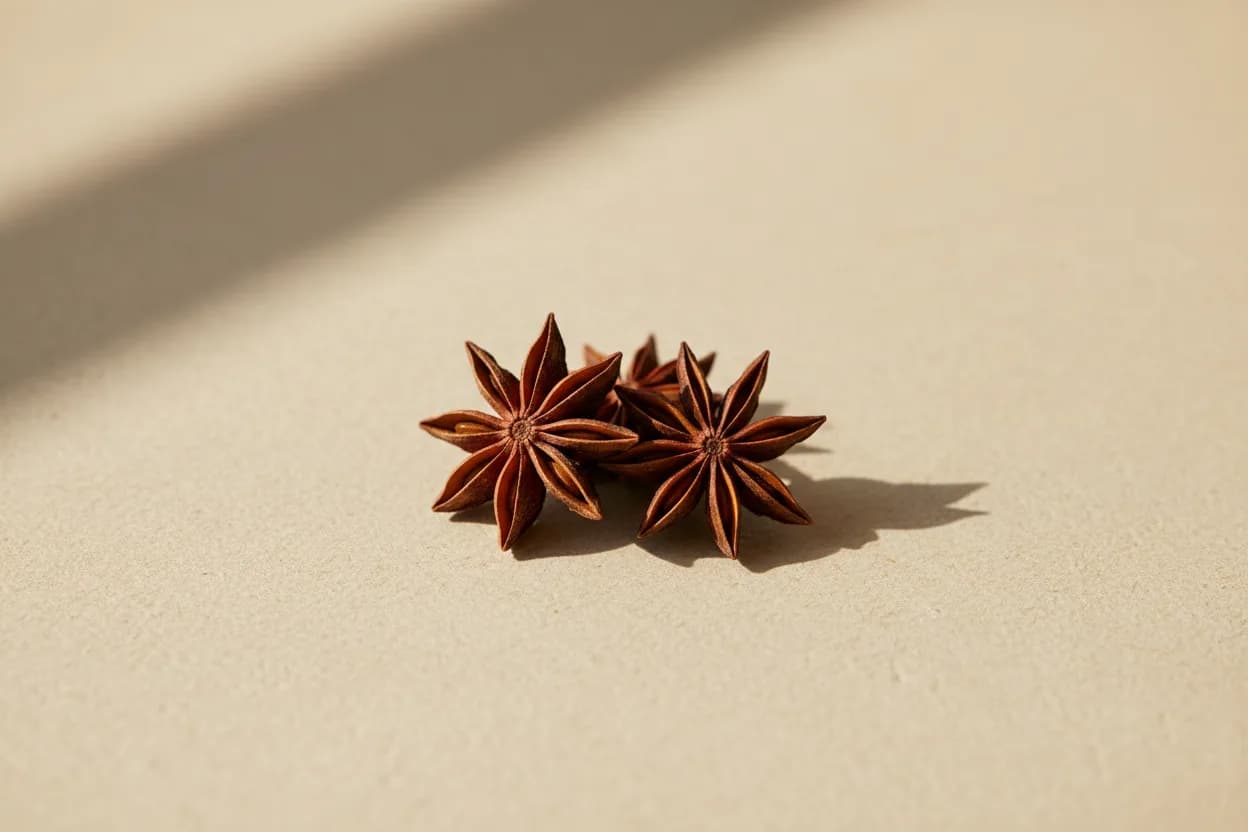
Star anise is the fruit of Illicium verum, an evergreen tree native to southern China and northern Vietnam, with Guangxi as its production heartland. 1 The fruit is an aggregate of follicles arranged in a star, usually eight of them, each split open around a single glossy seed, picked just before full ripeness and dried until it goes hard and reddish-brown. It is one of the few spices whose common name is a straightforward description of the thing.
Three unrelated plants, one smell
The dominant volatile is trans-anethole, C₁₀H₁₂O, and it is dominant to an unusual degree, typically somewhere between 72 and 92 per cent of the essential oil. 2 1 That is a spice speaking with almost one voice.
Here is the part that should be stranger than it usually sounds. Anise seed and fennel produce the same molecule, and they are not related to star anise. Star anise sits in the Schisandraceae. Anise and fennel are both Apiaceae, the carrot and parsley family. Two lineages that diverged an extremely long time ago arrived independently at the same aromatic compound, and human beings, tasting them, sorted them into the same flavour category and gave them nearly the same name. The kitchen taxonomy tracks the chemistry, not the botany, and in this case the chemistry converged twice.
Anethole is also noticeably sweet on its own, on the order of ten times sweeter than sucrose, which is part of why star anise reads as warm and confectionery even in an entirely savoury braise. The precise multiple gets quoted with more confidence than the underlying measurements support, so treat it as an order of magnitude rather than a figure.
The Tamiflu years
For a few years in the mid-2000s this spice was a pharmaceutical bottleneck, and the reason is a compound with nothing to do with its flavour. Star anise fruit contains around 7.1 per cent shikimic acid by dry weight. 3 Shikimic acid sits at a junction of the shikimate pathway, the route plants use to build aromatic amino acids, and it happens to have a ring bearing hydroxyl groups in an arrangement synthetic chemists find extremely convenient.
Roche's process chemists used it as the chiral starting material for oseltamivir, sold as Tamiflu. Their published routes run through epoxide chemistry, azide-free diamination, and mesylate displacement to build the neuraminidase inhibitor. 4 Read that sentence again and note what it describes: many steps of hard synthetic transformation.
This is the point where popular writing goes off a cliff, so let me be blunt. Shikimic acid is not antiviral. It does not inhibit neuraminidase. It is scaffolding, chosen because it is cheap and already the right shape, and it has to be extensively rebuilt before anything resembling a drug exists. Drinking star anise tea delivers no more flu treatment than chewing a fence post delivers furniture. Any article telling you star anise is nature's Tamiflu has misread a supply chain as a pharmacology.
The supply story was real enough, though. When H5N1 drove governments to stockpile Tamiflu in 2005, the constraint traced back to shikimic acid, and therefore to star anise harvests concentrated in a few Chinese provinces and subject to one growing season and the weather. Prices spiked. Roche's answer was to leave the plant behind: by 2006 the company was targeting up to 400 million treatment courses a year, a more than tenfold increase over its 2004 capacity, and doing it by replacing most of the star anise extraction with engineered Escherichia coli fermenting shikimic acid from glucose. 5 Bacteria in a tank, cheaper and faster and indifferent to typhoons.
The dark twin
There is a second reason to be careful here, and it is the one that actually matters in a kitchen. Illicium anisatum, Japanese star anise or shikimi, looks very nearly identical to the real thing once dried. Same star, same size, roughly the same colour. It is also toxic.
Its active principle is anisatin, and the mechanism is nasty and precise: it is a potent non-competitive antagonist at the GABA-A receptor, the same site picrotoxin acts on. 6 GABA is the brain's main inhibitory signal, so blocking it removes the brakes, and the clinical picture is seizures. Onset runs from about thirty minutes to six hours after ingestion.
Adulteration has genuinely happened, and it is not detectable by eye; distinguishing the two species reliably requires molecular or chemical methods. 7 In 2003 the US FDA advised the public to stop drinking star anise tea altogether, after roughly forty reported illnesses, about fifteen of them in infants. The advisory did not say Chinese star anise was unsafe; it said nobody could tell which one was in the packet.
The case reports are specific and sad, and they share a pattern. A two-month-old in Switzerland was given star anise tea for colic and went cyanotic and rigid; anisatin was found in the infant's urine. 8 A two-week-old in Rhode Island, same remedy, same presentation, published in 2021. Both recovered. The through line is that the tea was given to a baby for wind, which is a piece of folk practice widespread enough that this keeps recurring decades apart.
Europe ran the control experiment and it worked. In February 2002 the Commission imposed mandatory documentary checks and certification on all star anise imported from outside the EU, after contaminated consignments were linked to poisonings. Eighteen months later, with no further contamination found and no new cases, it repealed the measure. 9 A food safety rule that was imposed, did its job, and was then retired is rare enough to be worth noticing.
This should not put you off the spice. Buy Chinese star anise from a supplier who knows which species they are selling, keep it out of infant tea, and enjoy the fact that the warm sweetness in your braise is the same molecule fennel makes, arrived at independently, by a tree on the other side of the plant kingdom.
Sources
Every numbered claim above points here. Links go to the paper, record, or authority itself.
- 1.
Sharafan M, Jafernik K, Ekiert H, et al. Illicium verum (Star Anise) and Trans-Anethole as Valuable Raw Materials for Medicinal and Cosmetic Applications. Molecules. 2022;27(3):650.
https://doi.org/10.3390/molecules27030650 - 2.
PubChem Compound Summary CID 637563, trans-Anethole. National Center for Biotechnology Information.
https://pubchem.ncbi.nlm.nih.gov/compound/637563 - 3.
Aniya, Nomura Y, Fuerdeng, Appiah KS, Fujii Y. Evaluation of allelopathic activity of Chinese medicinal plants and identification of shikimic acid as an allelochemical from Illicium verum Hook. f. Plants. 2020;9(6):684.
https://doi.org/10.3390/plants9060684 - 4.
Karpf M, Trussardi R. New, azide-free transformation of epoxides into 1,2-diamino compounds: synthesis of the anti-influenza neuraminidase inhibitor oseltamivir phosphate (Tamiflu). Journal of Organic Chemistry. 2001;66(6):2044-2051.
https://doi.org/10.1021/jo005702l - 5.
Washam C. Pharmaceuticals: An Outbreak of New Sources of Avian Flu Drug. Environmental Health Perspectives. 2006;114(8):A464.
https://pmc.ncbi.nlm.nih.gov/articles/PMC1551983/ - 6.
Kudo Y, Oka JI, Yamada K. Anisatin, a potent GABA antagonist, isolated from Illicium anisatum. Neuroscience Letters. 1981;25(1):83-88.
https://doi.org/10.1016/0304-3940(81)90105-1 - 7.
Techen N, Pan Z, Scheffler BE, Khan IA. Detection of Illicium anisatum as adulterant of Illicium verum. Planta Medica. 2009;75(4):392-395.
https://doi.org/10.1055/s-0028-1112219 - 8.
Perret C, Tabin R, Marcoz JP, Llor J, Cheseaux JJ. Malaise grave du nourrisson: pensez à l'intoxication à la badiane! (Apparent life-threatening event in infants: think about star anise intoxication). Archives de Pédiatrie. 2011;18(7):750-753.
https://doi.org/10.1016/j.arcped.2011.03.024 - 9.
Commission Decision 2003/602/EC of 12 August 2003 repealing Decision 2002/75/EC laying down special conditions on the import of star anise from third countries. EUR-Lex.
https://eur-lex.europa.eu/legal-content/EN/TXT/?uri=CELEX%3A32003D0602