The state taxed the grind, and the coffee was never dark
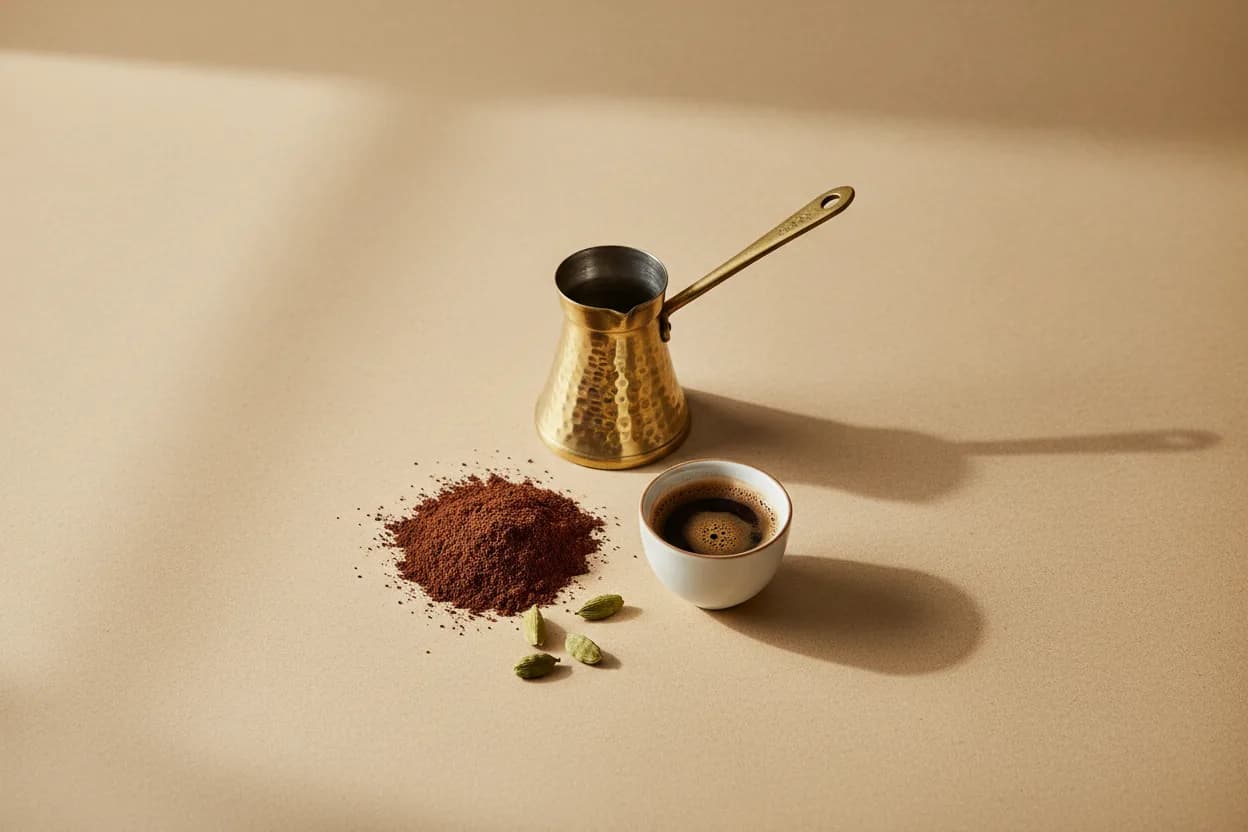
Finely ground coffee boiled without a filter is one drink under a dozen national names. The Ottoman treasury took a fifth of the cost of grinding it and made it illegal for a coffeehouse to own a mortar. Almost everything else people say about the style, including the dark roast and the regional spice map, turns out to be undocumented.
Contents
In Ottoman cities a coffeehouse keeper was not permitted to grind his own beans. He carried them to a tahmishane, a grinding house, where they went into a hollowed stone called a dibek and were pounded to powder with an iron pestle. Tahmis comes from an Arabic verb meaning to divide in five, because one fifth of the cost of the grinding was collected by the state. Keeping a mortar on your own premises was against the law. The law was broken constantly, and the monopoly survived until 1868. 1
A treasury that taxes one step has decided that the step is the product, and here it was right. Everything about this coffee follows from the powder and from what happens to the powder next, which is nothing at all. It goes into the pot, it goes into the cup, and it settles. The chemistry literature files the style alongside Scandinavian boiled coffee and the cafetière under a single heading, unfiltered, and that heading carries more weight than any of the things people actually argue about. 18
Peeled, roasted, pounded, boiled
The drink was taken up in Yemen in the middle of the fifteenth century by Sufi adherents who used it to stay awake through the night for dhikr, the first such use attributed to the order of Sheikh al-Shadhili. 2 By the end of that century it had reached Mecca and Cairo. 1 The Turkish reference literature agrees on both points: coffee became known in Yemen in the fifteenth century, and it was first appreciated in Sufi circles. 3
An Ottoman poem of the sixteenth or seventeenth century, by a poet called Nagzi, personifies coffee and follows him on his travels. The line describing what is done to him is the entire method in six words.
His covering was peeled off; he was roasted, pounded, and boiled.
The poem then sends him from Yemen to Mecca, Damascus, Aleppo, Cairo and at last Istanbul. 2 The bean itself had arrived in the capital by ship in AH 950, which is 1543, according to Kâtib Çelebi. 3
The coffeehouses came about a decade later, and the sources disagree about exactly when. İbrahim Peçevi writes that the first two opened in the Tahtakale district, kept by Hakem, a merchant from Aleppo, and Şems, from Damascus, in AH 962, a hijri year straddling late 1554 and late 1555. 4 His contemporary Mustafa Âlî puts it at AH 960, two years earlier. 3 The confident 1554 you will read almost everywhere is a lunar year flattened into a solar one, with a rival chronicler quietly dropped.
Then came the prohibitions, which are datable in a way that origin legends never are. Coffeehouses were closed in Homs in 1559, in Aleppo, Damascus and Jerusalem in 1565, and in Istanbul and Galata in 1568, where they were classed with taverns. 3 In 1578 the sultan reissued a decree to the governor of Bursa demanding that "coffeehouses, the gathering place for the sinful, should be banned". Reissuing a decree is an admission that the first one failed, and the historians who read these documents say so plainly: consumers and coffeehouse owners resisted together, and the resistance worked. 2
The best evidence that the grounds always stayed in the cup comes from a piece of theatre. In 1582 the coffeehouse guild performed at a festival in Istanbul with the sultan watching, and the scene the court narrator recorded has the poorest customers asking the owner for more coffee, then begging him to at least boil the grounds left in their cups for free. 2 A second boil of the same powder, played for laughs, in front of the sultan.
From there it moved west quickly. Peçevi visited an elaborately furnished coffeehouse in Sarajevo in 1591, with different sets of divans reserved for different social classes, and recorded Ottoman troops drinking coffee in Hungary on 4 August 1598. 1 By the early 1840s an English observer put the number of coffeehouses in Istanbul at no fewer than 2,500. 1
Which country drinks which blend
This is the question I set out to answer, and the honest answer is that almost none of it is written down. I could find no peer-reviewed, standards or ethnographic documentation of a distinct Syrian, Lebanese, Palestinian or Jordanian roast or blend. Mastic coffee is real, but the only evidence I could verify for it is a commercial category on the Greek market, sitting alongside a cardamom one. 5 Damascene rose and nutmeg in coffee return nothing at all: not one analytical paper, not one sensory study, not one ethnographic description.
There is a structural reason for the silence. In 2023 Türkiye imported about 93 million kilograms of green coffee against 11 million kilograms already roasted, and Saudi Arabia about 71 million against 12 million. Close to nine tenths of the coffee arrives raw in both countries. 15 The roast profile and the blend are therefore decided at home, by roasters, as a commercial judgement they are competing on. Nobody publishes the thing they are competing on.
The dark roast that isn't
Which brings me to a belief I held myself until this week. Everyone knows this coffee is dark roasted. In 2023 a group in Athens characterised 57 ground coffees from the Greek market, all of them sold for exactly this brewing method, boiled as fine powder in a cezve or briki. The largest category by a wide margin was light blonde roast blends, at 25 samples. Medium accounted for 11. Dark accounted for 6. 5
The only Turkish coffee I found whose composition was specified in detail, in a Jordanian crossover trial, was made from "equal parts of medium and dark roasted Arabica beans" to the manufacturer's specification. 6 UNESCO's inscription, which is Türkiye's own account of the practice, describes freshly roasted beans ground to a fine powder, added to a pot with cold water and sugar, and brewed slowly to raise the foam. It names no roast level and no spice. 24
It gets worse for the whole framing. A 2025 paper on roast colour states flatly that there are no universally accepted industry standards for what light, medium or dark roast mean, and that a coffee reading 40 on one commercial colour device will not read 40 on another. 8 Six mutually incompatible systems are in use. So the confident roast ladder people draw between Athens, Istanbul and Riyadh is built from units that do not convert.
The difference is the cardamom, and it is enormous
Where a regional divide does show up in the literature is in the spice, and the proportions are not what a Western spiced-coffee recipe would prepare you for. Three Saudi formulations published in 2025, from the Eastern, Northern and Middle regions, all specify 40 g of coffee to 800 mL of water and 30 g of ground cardamom. 9 A 2021 clinical trial used 30 g of coffee and 10 g of cardamom. 10 At the other end of the range, a 2023 trial used a teaspoon of cardamom to a litre. 11
Take the heavier end seriously for a moment. Thirty grams of cardamom to forty grams of coffee is three quarters of the coffee's own mass. That is not a flavouring, it is a second ingredient. The one carefully specified Turkish coffee in the same body of literature was prepared "without cardamom or any other additions". 6 Between the two traditions, the spice is the difference somebody has actually written down.
The stereotype breaks inside its own source, too. Of those three Saudi formulations, the Northern one uses a dark roast and no saffron, while the Eastern and Middle ones use a medium roast with saffron, and only the Middle adds cloves, half a gram of them. 9 One paper, three recipes, and one of the three refuses to behave. A separate trial specifies lightly roasted beans with cardamom, cloves and saffron together. 11 There is no regional spice map in the literature, only a handful of study protocols that happened to record what went into the pot.
The chemistry does at least explain why cardamom survives this treatment. Its essential oil runs to about 90 per cent oxygenated compounds, dominated by α-terpinyl acetate at roughly 44 per cent and 1,8-cineole at 30 per cent, with terpene hydrocarbons under 10 per cent of the total. 12 Oxygenated monoterpenes dissolve in water more readily and travel in steam more readily than the hydrocarbons that dominate citrus oils. For a spice thrown into an open pot at a rolling boil, that is close to the ideal profile.
What nobody has done is measure it. I searched the indexed literature several ways and found no analytical or sensory study of cardamom-spiced coffee at all: nothing on what it does to extraction, to the aroma profile, to antioxidant capacity, to the diterpene load. Every explanation you will read for why cardamom went into qahwa, that it cuts bitterness, that it settles the stomach, that it covers poor beans, is folk reasoning. The practice is centuries old and the measurement has never been taken.
Gulf regulation treats the two halves as separate products, which is its own kind of evidence. The GCC standard for roasted coffee covers whole and ground beans of the genus Coffea and explicitly excludes ground roasted coffee containing additives. 13 The cardamom side falls under a different standard entirely, for prepackaged mixed improvers of Arabic coffee, filed under spices and condiments. 14 Officially there is no such single object as qahwa. There are beans, and there is a condiment you bring to them.
What the missing filter does
Cafestol and kahweol are diterpenes carried in coffee oil, and they are why unfiltered coffee behaves differently in the body from filtered coffee. In one brew-by-brew comparison, a boiled unfiltered preparation measured 232 mg/L of cafestol and 1,016 mg/L of kahweol. Filtered coffee in the same study measured 5 mg/L and 1.8 mg/L. 17 That is roughly one forty-sixth and one five-hundred-and-sixtieth of the boiled brew.
The mechanism is plain enough that one paper stated it in its title: the cholesterol-raising factor from boiled coffee does not pass a paper filter. 19 Hot water extracts the diterpenes and the filter holds them back. 18 The identification came from feeding the compounds directly. Fifteen volunteers on a non-triglyceride fraction of coffee oil for four weeks raised mean cholesterol by 48 mg/dL against placebo, and the same oil stripped of cafestol and kahweol did nothing at all. 20
Two honest limits on that. The clinical work is Finnish, Norwegian and Dutch, done on Scandinavian boiled coffee rather than on anything from a cezve. 20 19 Turkish coffee itself has been tested in humans once that I could find: a pilot trial of 40 healthy women aged 18 to 25 drinking three 40 mL cups a day for four weeks, which reported higher LDL cholesterol, systolic pressure up 3.0 mmHg, heart rate up 10.6 beats per minute and worse insomnia scores. 7 Forty young women over four weeks points the same way as the Nordic trials without carrying anything like their weight.
The dose is not equal either. When one group brewed Saudi and Turkish coffee under an identical protocol, 20 g of beans in 500 mL of water for ten minutes, the mean caffeine came out at 49.8 mg per 100 mL for the Saudi preparation and 129.6 mg per 100 mL for the Turkish. 16 The same gesture, the same pot, two and a half times the caffeine.
One more belief to overturn while we are here. Acrylamide forms during roasting by the Maillard route, peaks between 160 and 180 °C, and degrades above 180 °C, so light and medium roasts carry more of it than dark ones. 21 Measured in Arabic coffee roasted in a laboratory, light came out highest at 410 µg/kg, dark at 360, medium at 310. 22 And yet a Saudi market survey found packaged qahwa at 73 to 108 µg/kg against 152 to 682 for ordinary coffee. 23 Mechanism and measurement point in opposite directions and nobody has reconciled them. Possibly the marketed qahwa is a coffee and cardamom mixture and the coffee is simply diluted. Nobody has checked that either.
Whose coffee
UNESCO's Representative List carries the same broad practice twice, under two different ethnonyms, inscribed nine years apart. Türkiye inscribed Turkish coffee culture and tradition in 2013. 24 The United Arab Emirates, Saudi Arabia, Oman and Qatar inscribed Arabic coffee, a symbol of generosity, in 2015, and the element was extended in 2024 to add Jordan. 25 Neither nomination claims exclusivity, and the list is not an adjudication of origin. There is no Greek, Cypriot, Bosnian or Armenian coffee element on it at all.
The Greek renaming is the case everyone cites and it is usually told wrong. There was no decree. What is documented is a slow social and commercial shift: the food scholar Albert Arouh, who grew up there, says that in the 1960s everyone in Greece called it Turkish coffee, and that the 1974 invasion of Cyprus sparked the nationalism that pushed the old name out. By the 1980s ordering it that way had become awkward, and Greek companies ran advertisements announcing what the country drank. A second motive was purely commercial: the new name also separated the drink from the frappé, espresso and cappuccino then arriving. 26
The Bosnian case is better sourced and stranger. In the period studied by the folklorist Dorian Jurić, the ordinary names were turska kahva and domaća kahva, Turkish coffee and homemade coffee. Bosanska kahva, Bosnian coffee, was used very rarely, and usually with the tongue in the cheek. 1 The firm correction a visitor gets in Sarajevo today is recent, and it arrived a long time after the coffee did.
Even the vessels refuse to line up. In Turkish the pot is the cezve, a word taken from Arabic; the ibrik is a handled, spouted vessel for water, so the English coffee trade's habit of calling the brewing pot an ibrik reads oddly to a Turkish speaker. 27 28 Greek bríki does come from ibrik, and in Greek it does mean the coffee pot. 29 In Egyptian Arabic the pot is the kanaka, from a Persian word for sheet metal, and the sludge at the bottom is the telve, borrowed straight from Turkish. 30
That sludge is still there at the end, and people read it. UNESCO's description mentions the practice: the cup is turned over onto the saucer, left to cool, and the shapes inside are interpreted. 24 In 2025 three researchers recorded 22 informal cup-reading sessions among 25 Turkish-speaking women, two hours and forty minutes of talk, and asked what the sessions were doing rather than whether the readings were true. Their answer was that the ritual opens a space for solidarity, a licensed way into what they call troubles talk. 31
It is a strange thing to owe to an absence. The treasury taxed the pounding because the powder was the product, the powder stayed in the cup because nobody strained it, and the residue at the bottom turned into a way of saying difficult things out loud on an ordinary afternoon. All of it follows from a filter that nobody ever put in.
Sources
Every numbered claim above points here. Links go to the paper, record, or authority itself.
- 1.
Jurić D. Conveying Ćeif: Three Croatian Folklore and Folklife Writings on Bosniak Coffee Culture. FOLKLORICA: Journal of the Slavic, East European, and Eurasian Folklore Association. 2020;23.
https://doi.org/10.17161/folklorica.v23i.14968 - 2.
Karababa E, Ger G. Early Modern Ottoman Coffeehouse Culture and the Formation of the Consumer Subject. Journal of Consumer Research. 2011;37(5):737-760.
https://doi.org/10.1086/656422 - 3.
Bostan İ. Kahve. TDV İslâm Ansiklopedisi, vol. 24. Istanbul: Türkiye Diyanet Vakfı; 2001.
https://islamansiklopedisi.org.tr/kahve - 4.
Yaşar A. Kahvehane. TDV İslâm Ansiklopedisi, supplementary vol. 2. Istanbul: Türkiye Diyanet Vakfı; 2019.
https://islamansiklopedisi.org.tr/kahvehane - 5.
Tsiaka T, Kritsi E, Bratakos SM, et al. Quality Assessment of Ground Coffee Samples from Greek Market Using Various Instrumental Analytical Methods, In Silico Studies and Chemometrics. Antioxidants. 2023;12(6):1184.
https://doi.org/10.3390/antiox12061184 - 6.
Elsahoryi NA, Ibrahim MO, Alhaj OA, Hammouh F. Acute Cardiovascular Effects of Turkish Coffee Assessed by VO2 Test: A Randomized Crossover Trial. Nutrients. 2025;17(5):823.
https://doi.org/10.3390/nu17050823 - 7.
Elsahoryi NA, Alhaj OA. Short-Term Turkish Coffee Consumption Elevates Cardiovascular Risk Markers, Decreases Leptin Levels, and Impairs Sleep Quality in Healthy Young Women: A Pilot Randomized Controlled Trial. International Journal for Vitamin and Nutrition Research. 2026;96(1):46713.
https://doi.org/10.31083/ijvnr46713 - 8.
Anokye-Bempah L, Styczynski T, Ristenpart WD, Donis-González IR. A universal color curve for roasted arabica coffee. Scientific Reports. 2025.
https://doi.org/10.1038/s41598-025-06601-w - 9.
Alrabeah GO, AlGhazzi AA, AlOtaibi NH, AlAnzan AN, AlOtaibi KF. Evaluation of the Effect of Saudi Coffee Consumption in Comparison to Various Types of Coffees on the Color of Novel Aesthetic Dental Ceramics. The Saudi Dental Journal. 2025.
https://doi.org/10.1007/s44445-025-00047-6 - 10.
Alzoman H, Alzahrani A, Alwehaiby K, Alanazi W, AlSarhan M. Efficacy of Arabic Coffee and Black Tea in Reducing Halitosis: A Randomized, Double-Blind, Controlled, Crossover Clinical Trial. Healthcare. 2021;9(3):250.
https://doi.org/10.3390/healthcare9030250 - 11.
Jalal SM, Alsebeiy SH, Aleid HA, Alhamad SA. Effect of Arabic Qahwa on Blood Pressure in Patients with Stage One Hypertension in the Eastern Region of Saudi Arabia. Journal of Personalized Medicine. 2023;13(6):1011.
https://doi.org/10.3390/jpm13061011 - 12.
Pavarino M, Marengo A, Cagliero C, Bicchi C, Rubiolo P, Sgorbini B. Elettaria cardamomum (L.) Maton Essential Oil: An Interesting Source of Bioactive Specialized Metabolites as Inhibitors of Acetylcholinesterase and Butyrylcholinesterase. Plants. 2023;12(19):3463.
https://doi.org/10.3390/plants12193463 - 13.
GSO 2197:2024, Coffee and Coffee Products: Roasted Coffee Beans. GCC Standardization Organization; approved 31 October 2024.
https://www.gso.org.sa/store/standards/GSO:925595/?lang=en - 14.
GSO 2516:2016, Prepackaged Mixed Improvers of Arabic Coffee. GCC Standardization Organization; approved 12 May 2016.
https://www.gso.org.sa/store/standards/GSO:727991/?lang=en - 15.
UN Comtrade Database. Imports of coffee under HS 0901.11 (not roasted) and HS 0901.21 (roasted), reporters Türkiye and Saudi Arabia, partner World, 2023.
https://comtradeplus.un.org/ - 16.
Bawazeer NM, Binsunaid F, Alraqea A, et al. Comparative study of Saudi and Turkish coffee consumption in Saudi Arabia: insights into sociodemographic factors and caffeine intake. Frontiers in Nutrition. 2024;11:1407590.
https://doi.org/10.3389/fnut.2024.1407590 - 17.
Moeenfard M, Erny GL, Alves A. Variability of some diterpene esters in coffee beverages as influenced by brewing procedures. Journal of Food Science and Technology. 2016.
https://doi.org/10.1007/s13197-016-2378-6 - 18.
Urgert R, Katan MB. The cholesterol-raising factor from coffee beans. Annual Review of Nutrition. 1997;17:305-324.
https://doi.org/10.1146/annurev.nutr.17.1.305 - 19.
van Dusseldorp M, Katan MB, van Vliet T, Demacker PNM, Stalenhoef AFH. Cholesterol-raising factor from boiled coffee does not pass a paper filter. Arteriosclerosis and Thrombosis. 1991;11(3):586-593.
https://doi.org/10.1161/01.ATV.11.3.586 - 20.
Weusten-Van der Wouw MPME, Katan MB, Viani R, et al. Identity of the cholesterol-raising factor from boiled coffee and its effects on liver function enzymes. Journal of Lipid Research. 1994;35(4):721-733.
https://doi.org/10.1016/S0022-2275(20)41169-1 - 21.
da Costa DS, Albuquerque TG, Costa HS, Bragotto APA. Thermal Contaminants in Coffee Induced by Roasting: A Review. International Journal of Environmental Research and Public Health. 2023;20(8):5586.
https://doi.org/10.3390/ijerph20085586 - 22.
Alamri E, Rozan M, Bayomy H. A study of chemical composition, antioxidants, and volatile compounds in roasted Arabic coffee. Saudi Journal of Biological Sciences. 2022.
https://doi.org/10.1016/j.sjbs.2022.03.025 - 23.
Khan MR, Alothman ZA, Naushad M, Alomary AK, Alfadul SM, Alsohaimi IH, Algamdi MS. Occurrence of acrylamide carcinogen in Arabic coffee Qahwa, coffee and tea from Saudi Arabian market. Scientific Reports. 2017;7:41995.
https://doi.org/10.1038/srep41995 - 24.
UNESCO. Turkish coffee culture and tradition. Representative List of the Intangible Cultural Heritage of Humanity, Türkiye, inscribed 2013 (8.COM), reference 00645.
https://ich.unesco.org/en/RL/turkish-coffee-culture-and-tradition-00645 - 25.
UNESCO. Arabic coffee, a symbol of generosity. Representative List, inscribed 2015 (10.COM) by the United Arab Emirates, Saudi Arabia, Oman and Qatar; extended 2024 (19.COM) to include Jordan. Reference 02111.
https://ich.unesco.org/en/RL/arabic-coffee-a-symbol-of-generosity-02111 - 26.
Kakissis J. Don't Call It 'Turkish' Coffee, Unless, Of Course, It Is. NPR, The Salt. 27 April 2013.
https://www.npr.org/sections/thesalt/2013/04/27/179270924/dont-call-it-turkish-coffee-unless-of-course-it-is - 27.
Türk Dil Kurumu. Güncel Türkçe Sözlük, entry cezve.
https://sozluk.gov.tr/gts?ara=cezve - 28.
Türk Dil Kurumu. Güncel Türkçe Sözlük, entry ibrik.
https://sozluk.gov.tr/gts?ara=ibrik - 29.
Λεξικό της Κοινής Νεοελληνικής (Triantafyllidis Dictionary), entry μπρίκι. Centre for the Greek Language, Aristotle University of Thessaloniki.
https://www.greek-language.gr/greekLang/modern_greek/tools/lexica/triantafyllides/ - 30.
Rocchi L. Ottoman-Turkish Loanwords in Egyptian and Syro-Lebanese-Palestinian Arabic, Part 4. Studia Linguistica Universitatis Iagellonicae Cracoviensis. 2022;139(4):333-381.
https://doi.org/10.4467/20834624SL.22.016.16686 - 31.
Eröz B, Efeoğlu-Özcan E, Başaran Uysal BÇ. 'Neyse Halim Çıksın Falim': Turkish women's intimate discourse in fortune-telling sessions through coffee cup readings. Discourse Studies. 2025;27(1):82-105.
https://doi.org/10.1177/14614456241252894