Mint does not cool anything
Menthol lowers no temperature at all. It picks the lock on the receptor your nerves use to report cold, which is a far stranger thing to do.
Contents
Hold a mint leaf in your mouth and then breathe in. The cold that arrives on the inhale is completely convincing and completely false. Put a thermometer in there and nothing has moved. Menthol does not lower the temperature of anything. What it does instead is more interesting than cooling, and it took until 2002 for anyone to be able to say what it was.
Two laboratories, one year, two journals
In 2002 two independent groups published the same discovery within weeks of each other. David Julius's laboratory reported it in Nature, identifying a cold receptor and arguing that TRP channels do thermosensation generally. 1 Ardem Patapoutian's laboratory reported it in Cell, under a title that says the whole thing out loud: a TRP channel that senses cold stimuli and menthol. 2 Same channel, now called TRPM8. Different labs, different journals, same season.
The channel is a cold sensor in the ordinary sense. It begins to open somewhere around twenty-six to twenty-eight degrees and its activity climbs as the temperature keeps falling toward eight, which covers everything from a cool room to genuinely painful cold. 3 It is the principal detector of environmental cold, though worth noting the word principal: knock it out and some cold sensing survives.
What menthol actually does
Menthol binds TRPM8 and shifts its temperature-activation curve toward warmer temperatures. That is the entire trick. A channel that would otherwise need real cold to open now opens at ordinary skin or mouth temperature, the nerve fires, and the fibre reports what it always reports: cold. Your brain has no independent way to check. It receives a cold signal from a cold line and believes it, because under every other circumstance in your life that signal has been true. 3
This is a much better trick than cooling. Cooling would require energy and would fade. Menthol just lies to the sensor, and the sensation lasts as long as the molecule is sitting in the pocket.
A TRP channel that senses cold stimuli and menthol.
One clarification, because it gets garbled constantly. Julius and Patapoutian shared the 2021 Nobel Prize in Physiology or Medicine for their discoveries of receptors for temperature and touch. The prize was not awarded for TRPM8. The Nobel committee's own materials centre on TRPV1, the capsaicin and heat receptor Julius found in 1997, and on the PIEZO channels Patapoutian identified for mechanical touch, and describe the independent discovery of TRPM8 as a further advance that followed. 4 The menthol receptor is Nobel-adjacent, and that is a good enough story without inflating it.
Eight versions, one that works
Menthol is C₁₀H₂₀O, a cyclohexane ring with a hydroxyl, a methyl, and an isopropyl group hung off it. Three of its carbons are chiral centres, which means eight possible stereoisomers: menthol, neomenthol, isomenthol, neoisomenthol, each as a mirrored pair. 6
Nature essentially uses one of the eight. (−)-menthol, configuration 1R,2S,5R, is the form the plant makes, and when the eight are compared head to head it is also the most potent at the receptor, with the lowest cooling threshold of the set. 5 The molecule that plants happen to build is the one that fits the human channel best. That is not design, it is just what happens when a receptor evolves in a world that already contains terpenes.
Peppermint is a hybrid, spearmint is a different answer
Peppermint, Mentha × piperita, is not a species so much as an accident that stuck: a sterile hybrid of watermint and spearmint, and since spearmint is itself an old hybrid, peppermint is a hybrid of a hybrid. It was first described from a find in Hertfordshire and published by John Ray in 1696, and Linnaeus later named it as though it were a species, which it is not.
Spearmint is the useful comparison, because it makes almost no menthol. Its oil is dominated by carvone instead. Same genus, same terpene machinery, one different turn late in the pathway, and the entire sensory result changes: spearmint tastes of mint without doing the cold thing at all. If you have ever wondered why spearmint gum and peppermint gum are not interchangeable, that is the reason, and it is a single branch point in a biosynthetic route.
Be careful with the percentages you read. Figures of eighty per cent menthol usually describe Mentha arvensis, corn mint, which is the industrial source of crystalline menthol and a different plant. True peppermint oil generally runs lower and varies with growing conditions and processing. One controlled study measured fresh peppermint leaf oil at about 44 per cent menthol and 15 per cent menthone, with the numbers shifting measurably depending on how the leaf was dried, because drying drives oxidation, hydrolysis, and the loss of the more water-loving volatiles. 7
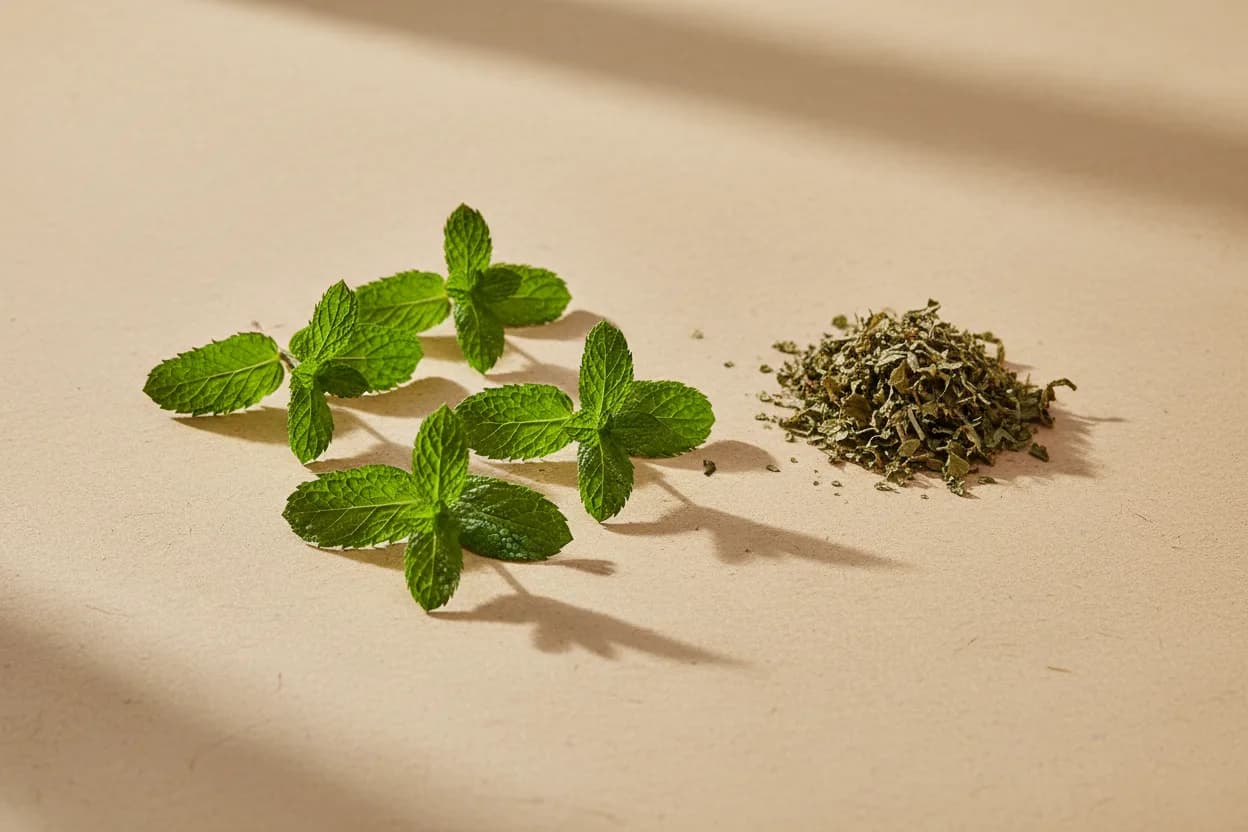
So dried mint does not work as a weaker version of fresh. The composition has changed, and every kitchen that uses both, from Persian ash to a Levantine bowl of cucumber and yogurt, treats them as two ingredients rather than one and a substitute. The plant is doing terpene chemistry either way, and the drying rack is just another step in it.
Sources
Every numbered claim above points here. Links go to the paper, record, or authority itself.
- 1.
McKemy DD, Neuhausser WM, Julius D. Identification of a cold receptor reveals a general role for TRP channels in thermosensation. Nature. 2002;416:52-58.
https://doi.org/10.1038/nature719 - 2.
Peier AM, Moqrich A, Hergarden AC, et al. A TRP channel that senses cold stimuli and menthol. Cell. 2002;108(5):705-715.
https://doi.org/10.1016/S0092-8674(02)00652-9 - 3.
Liman ER. TRPM8: The Cold and Menthol Receptor. In: TRP Ion Channel Function in Sensory Transduction and Cellular Signaling Cascades. CRC Press/Taylor & Francis; NCBI Bookshelf NBK5238.
https://www.ncbi.nlm.nih.gov/books/NBK5238/ - 4.
The Nobel Prize in Physiology or Medicine 2021, awarded jointly to David Julius and Ardem Patapoutian for their discoveries of receptors for temperature and touch. Press release, Nobel Assembly at Karolinska Institutet.
https://www.nobelprize.org/prizes/medicine/2021/press-release/ - 5.
Chen X, Xu L, Zhang H, Wen H, Yang F. Differential Activation of TRPM8 by the Stereoisomers of Menthol. Frontiers in Pharmacology. 2022;13:898670.
https://doi.org/10.3389/fphar.2022.898670 - 6.
PubChem Compound Summary CID 16666, (-)-Menthol. National Center for Biotechnology Information.
https://pubchem.ncbi.nlm.nih.gov/compound/16666 - 7.
Beigi M, Torki-Harchegani M, Ghasemi Pirbalouti A. Quantity and chemical composition of essential oil of peppermint (Mentha x piperita L.) leaves under different drying methods. International Journal of Food Properties. 2018;21(1):267-276.
https://doi.org/10.1080/10942912.2018.1453839