Chamomile makes its blue in the still, not in the field
German chamomile flowers are white and gold. Distil them and the oil runs ink-blue, from a molecule the living plant never contains. What is in the flower, what a cup of tea actually carries, and why the trials that made chamomile's name mostly did not use tea.
Contents
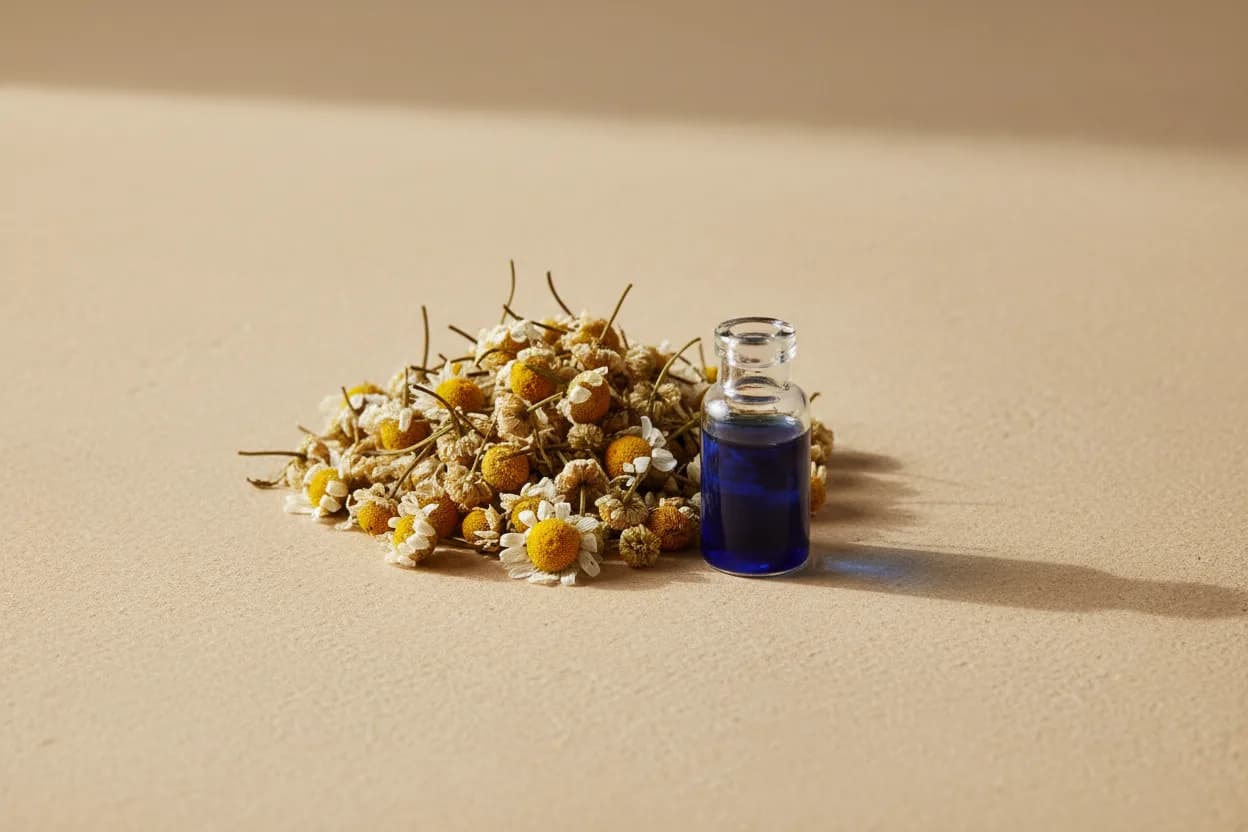
A chamomile flower is a small white daisy with a gold cone at its centre, and nothing about it is blue. Put a few kilograms of the dried heads in a still, pass steam through them, and the oil that separates on the far side is the colour of ink. The pigment is chamazulene, and the living plant does not contain it. The flower carries a colourless precursor called matricin, and it is the heat of the still that breaks matricin down into the deep-blue azulene. 1 Chamazulene is the most photographed thing about chamomile and it is, strictly, a manufacturing artefact.
That fact sets the tone for the rest of the flower. Chamomile has a real chemistry, a real pharmacology, and a large clinical literature, and the three do not line up as neatly as the tea-box copy suggests. This note walks through what the flower holds, what a cup of hot water pulls out of it, and what the trials that gave chamomile its reputation were actually made with.
Two plants share the name
There are two chamomiles in commerce and they are different genera. German chamomile, Matricaria chamomilla (the pharmacopoeias still often write Matricaria recutita), is an annual; Roman chamomile, Chamaemelum nobile, is a perennial that flowers earlier in the year. German chamomile's petals turn down as the head matures, leaving a raised conical centre, while the Roman flower's centre stays flat. 3 German chamomile is the one in tea bags. Roman chamomile is grown mostly for its oil, which goes to perfumers and cosmetic houses. 2
The two are chemically distinct, not just botanically. When Tai and colleagues compared their flowers in 2020, the German plant carried fifty times more alpha-bisabolol oxide A, thirty times more oxide B, and ten times more chamazulene than the Roman one, whose oil is built instead on a set of small esters. 2 Everything below is about German chamomile, the one that is an official drug in the pharmacopoeias of twenty-six countries. 3 1
What the still makes
Dried chamomile heads give up somewhere between 0.24 and 2 per cent of their weight as essential oil, and most cultivated batches sit at the low end of that range. 1 Two molecules dominate the oil: (-)-alpha-bisabolol, a sesquiterpene alcohol, and the chamazulene made in the still, and between them they account for half to two-thirds of it. 1 The proportions swing with the plant's chemotype. Growers recognise four, named for whichever compound leads: bisabolol, bisabolol oxide A, bisabolol oxide B, or bisabolone oxide A. 1 A bisabolol-oxide line can run to 30 per cent chamazulene while carrying under 1 per cent free bisabolol, so two bottles labelled chamomile oil can be quite different liquids. 1
Bisabolol is where chamomile's anti-inflammatory reputation lives, and the evidence behind it is mostly animal and bench work: mouse models of lung inflammation and cartilage damage, rat stomachs protected from alcohol, macrophages in a dish making less nitric oxide. The 2022 review that collects this literature says plainly that clinical efficacy and safety in people remain scarce and to be determined, with only a handful of small trials, topical formulations for the most part, to point to. 4 The whole oil relaxes isolated gut muscle in the laboratory, but at roughly a twentieth of the potency of the pharmaceutical comparator papaverine, gram for gram. 1
The oil also carries a polyacetylene called spiroether at 12 to 20 per cent in some batches, and two coumarins, herniarin and umbelliferone, with herniarin the more abundant: pure chamomile oil assayed at 540 micrograms of herniarin per millilitre. 1 Across the whole plant, ten different coumarins have been identified. 3 That matters later, when we get to blood thinners.
What the cup carries
Hot water is not a still, so a cup of chamomile tea contains very little of the oil and none of the blue. What it does pull out are the water-soluble phenolics, and the one everybody has heard of is apigenin. In the flower, apigenin is mostly bound to a sugar as apigenin-7-glucoside. Fresh flowers assayed at about 3 milligrams of the glucoside per gram; gentle drying kept about 2; oven-drying at 80 degrees cut it to 1, a two-thirds loss from the harshest regime. 1 Brewing shifts the mixture again. A 2010 analysis comparing chamomile flowers with the tea made from them found the tea richer in flavonoid glycosides such as rutin and poorer in free apigenin and its glucoside, so a cup is a different chemical mixture from the flower, not a dilution of it. 5
The tea is absorbed, though. Fourteen healthy volunteers who drank 200 millilitres a day for two weeks showed clear shifts in their urinary metabolites, with no one reporting side effects. 1 What no one has measured is how much free apigenin from a single cup reaches the blood, and that gap is where the most repeated claim about chamomile lives.
The claim is that apigenin acts on the brain's benzodiazepine site. Its origin is a 1995 paper by Viola and colleagues, who isolated apigenin from chamomile fractions and found it displaced a labelled benzodiazepine from receptors with a binding constant of 4 micromolar, then showed that mice given apigenin behaved less anxiously in a plus-maze, without sedation, without muscle relaxation, and without any anticonvulsant action. 6 It is a real result and a good paper. It is also a test-tube binding assay plus a mouse behaviour test, and 4 micromolar is a modest affinity for a drug. A year later, another group fractionated chamomile heads looking for the benzodiazepine-displacing activity and found that the main agent responsible was GABA itself, which the flower contains. 1 Nobody has shown that a cup of tea delivers enough free apigenin to the brain to matter, and the honest description is a laboratory receptor interaction with a mouse correlate, of unknown relevance at tea-cup doses.
The trials mostly did not use tea
Chamomile's clinical reputation rests on a series of trials from one group in Philadelphia, and they used a standardised extract in capsules. The first, in 2009, randomised 57 people with generalised anxiety disorder to extract or placebo for eight weeks and found a greater fall in anxiety scores on chamomile, with a P value of 0.047 and the authors' own caution that the effect was modest and needed replication. 7 The long-term follow-up in 2016 took 93 responders and randomised them to keep taking chamomile or switch to placebo for six months: the relapse rate was lower on chamomile, 15 versus 26 per cent, but the difference did not reach significance. 8 The Journal's note on herbs for chronic stress walks through those trials in more detail; what matters here is the form. These were 220 to 1,500 milligrams a day of a pharmaceutical-grade extract, not an infusion.
Sleep is where the gap is starkest. The one dedicated trial in chronic primary insomnia, Zick and colleagues in 2011, gave 34 adults a standardised extract for four weeks and found no significant difference from placebo on any sleep-diary measure. The extract was standardised to at least 2.5 milligrams each of apigenin and bisabolol per capsule, and the authors calculated that their dose represented 15 grams of chamomile flowers a day, an amount that, in their words, could not feasibly be delivered as a tea. 9 The trial that actually used tea is a 2016 study of 80 Taiwanese women with poor sleep after childbirth: two weeks of chamomile tea improved sleep and mood scores against routine care, and by the four-week follow-up the two groups were indistinguishable again. 10
A 2019 meta-analysis of twelve randomised trials draws the lines carefully. Pooled, chamomile improved sleep quality and generalised anxiety scores; it did not improve state anxiety, and on insomnia as a diagnosis there was one trial, the null one above. 11 A review devoted to chamomile tea specifically, rather than extract, put the situation in one sentence in 2006, and it is still true: clinical trials examining the purported sedative properties of chamomile tea are absent. 12
Who should hesitate
Chamomile is a daisy, and the daisy family is a common allergen. The clearest case in the literature is an eight-year-old boy with pollen allergies who had a severe anaphylactic reaction to his first ever cup of chamomile tea; the investigators showed his antibodies cross-reacted between chamomile, giant ragweed and mugwort pollen. 14 The NIH puts it simply: people allergic to ragweed, chrysanthemums, marigolds or daisies are more likely to react to chamomile, and the EU monograph makes Asteraceae allergy its one contraindication. 16 13 Those coumarins are the other flag. A 70-year-old woman on warfarin was admitted with multiple internal haemorrhages after taking chamomile tea and chamomile lotion for a cold; a single case, and a combined exposure, but enough for the authors to ask that warfarin patients be warned. 15 On pregnancy, the honest answer is the NIH's: little is known about whether it is safe. That is a gap in the evidence, not a demonstrated harm, and it cuts both ways. 16
The Greeks called the plant khamaimelon, earth apple, for the way it grows low and smells faintly of apples, and the word came into English around 1300 with that meaning intact. 17 Seven centuries later, the cup is still doing the thing the name describes: a small, apple-scented flower steeped in hot water, warm, mild, and pleasant to hold at the end of a day. The extract in the trials is a different product. The blue oil is a third. The tea has never needed to borrow their claims.
Questions this note answers
- Is chamomile tea the same as the chamomile extract used in clinical trials?
- No. The anxiety trials used 220 to 1,500 milligrams a day of a standardised capsule extract, and the insomnia trial's dose represented 15 grams of flowers a day, which its authors said could not feasibly be delivered as a tea. Brewing also shifts the chemistry toward flavonoid glycosides and away from free apigenin. 8 9 5
- Does chamomile tea help you sleep?
- The evidence is thin. The only trial in diagnosed insomnia, using extract, found no difference from placebo, and a 2019 meta-analysis found a benefit for self-rated sleep quality but not for insomnia. The one trial of actual tea, in women after childbirth, found an improvement that had faded by four weeks. 9 11 10
- Who should avoid chamomile?
- People allergic to ragweed, mugwort, chrysanthemums or other daisies, since chamomile pollen cross-reacts and a documented anaphylaxis followed a first cup. Anyone on warfarin should ask first, after a reported case of internal bleeding. In pregnancy the safety data are simply missing. 14 15 16
- Does chamomile tea help the stomach and bloating?
- Yes, but only as a traditional-use claim, not a trial-tested one. The EU's 2015 herbal monograph lists chamomile flower for minor gastrointestinal complaints such as bloating and minor spasms, at a dose of 1.5 to 4 grams of flower in 150 millilitres of boiling water, three to four times a day. That category rests on long-standing use rather than clinical evidence, and sleep and anxiety are not on the same list. 13
Sources
Every numbered claim above points here. Links go to the paper, record, or authority itself.
- 1.
Cosmetic Ingredient Review Expert Panel. Safety Assessment of Chamomile Ingredients as Used in Cosmetics: Scientific Literature Review. Washington, DC; 11 February 2013.
https://www.cir-safety.org/sites/default/files/chamom022013slr.pdf - 2.
Tai Y, Hou X, Liu C, et al. Phytochemical and comparative transcriptome analyses reveal different regulatory mechanisms in the terpenoid biosynthesis pathways between Matricaria recutita L. and Chamaemelum nobile L. BMC Genomics. 2020;21:169.
https://doi.org/10.1186/s12864-020-6579-z - 3.
Dai YL, Li Y, Wang Q, et al. Chamomile: A Review of Its Traditional Uses, Chemical Constituents, Pharmacological Activities and Quality Control Studies. Molecules. 2022;28(1):133.
https://pmc.ncbi.nlm.nih.gov/articles/PMC9822300/ - 4.
Eddin LB, Jha NK, Goyal SN, et al. Health Benefits, Pharmacological Effects, Molecular Mechanisms, and Therapeutic Potential of α-Bisabolol. Nutrients. 2022;14(7):1370.
https://pmc.ncbi.nlm.nih.gov/articles/PMC9002489/ - 5.
Nováková L, Vildová A, Mateus JP, Gonçalves T, Solich P. Development and application of UHPLC-MS/MS method for the determination of phenolic compounds in Chamomile flowers and Chamomile tea extracts. Talanta. 2010;82(4):1271-1280.
https://pubmed.ncbi.nlm.nih.gov/20801328/ - 6.
Viola H, Wasowski C, Levi de Stein M, et al. Apigenin, a component of Matricaria recutita flowers, is a central benzodiazepine receptors-ligand with anxiolytic effects. Planta Medica. 1995;61(3):213-216.
https://pubmed.ncbi.nlm.nih.gov/7617761/ - 7.
Amsterdam JD, Li Y, Soeller I, Rockwell K, Mao JJ, Shults J. A randomized, double-blind, placebo-controlled trial of oral Matricaria recutita (chamomile) extract therapy for generalized anxiety disorder. Journal of Clinical Psychopharmacology. 2009;29(4):378-382.
https://pubmed.ncbi.nlm.nih.gov/19593179/ - 8.
Mao JJ, Xie SX, Keefe JR, Soeller I, Li QS, Amsterdam JD. Long-term chamomile (Matricaria chamomilla L.) treatment for generalized anxiety disorder: a randomized clinical trial. Phytomedicine. 2016;23(14):1735-1742.
https://pubmed.ncbi.nlm.nih.gov/27912875/ - 9.
Zick SM, Wright BD, Sen A, Arnedt JT. Preliminary examination of the efficacy and safety of a standardized chamomile extract for chronic primary insomnia: a randomized placebo-controlled pilot study. BMC Complementary and Alternative Medicine. 2011;11:78.
https://pmc.ncbi.nlm.nih.gov/articles/PMC3198755/ - 10.
Chang SM, Chen CH. Effects of an intervention with drinking chamomile tea on sleep quality and depression in sleep disturbed postnatal women: a randomized controlled trial. Journal of Advanced Nursing. 2016;72(2):306-315.
https://pubmed.ncbi.nlm.nih.gov/26483209/ - 11.
Hieu TH, Dibas M, Surya Dila KA, et al. Therapeutic efficacy and safety of chamomile for state anxiety, generalized anxiety disorder, insomnia, and sleep quality: A systematic review and meta-analysis of randomized trials and quasi-randomized trials. Phytotherapy Research. 2019;33(6):1604-1615.
https://pubmed.ncbi.nlm.nih.gov/31006899/ - 12.
McKay DL, Blumberg JB. A review of the bioactivity and potential health benefits of chamomile tea (Matricaria recutita L.). Phytotherapy Research. 2006;20(7):519-530.
https://pubmed.ncbi.nlm.nih.gov/16628544/ - 13.
European Medicines Agency, Committee on Herbal Medicinal Products. European Union herbal monograph on Matricaria recutita L., flos. EMA/HMPC/55843/2011; adopted 7 July 2015.
https://www.ema.europa.eu/en/documents/herbal-monograph/final-european-union-herbal-monograph-matricaria-recutita-l-flos-first-version_en.pdf - 14.
Subiza J, Subiza JL, Hinojosa M, et al. Anaphylactic reaction after the ingestion of chamomile tea: a study of cross-reactivity with other composite pollens. Journal of Allergy and Clinical Immunology. 1989;84(3):353-358.
https://pubmed.ncbi.nlm.nih.gov/2674263/ - 15.
Segal R, Pilote L. Warfarin interaction with Matricaria chamomilla. CMAJ. 2006;174(9):1281-1282.
https://pubmed.ncbi.nlm.nih.gov/16636327/ - 16.
National Center for Complementary and Integrative Health. Chamomile: Usefulness and Safety. National Institutes of Health.
https://www.nccih.nih.gov/health/chamomile - 17.
Harper D. Chamomile. Online Etymology Dictionary.
https://www.etymonline.com/word/chamomile