chamomile flowers
Matricaria chamomilla
IN ARABIC زهور البابونج
The classic calming daisy.
ABOUT
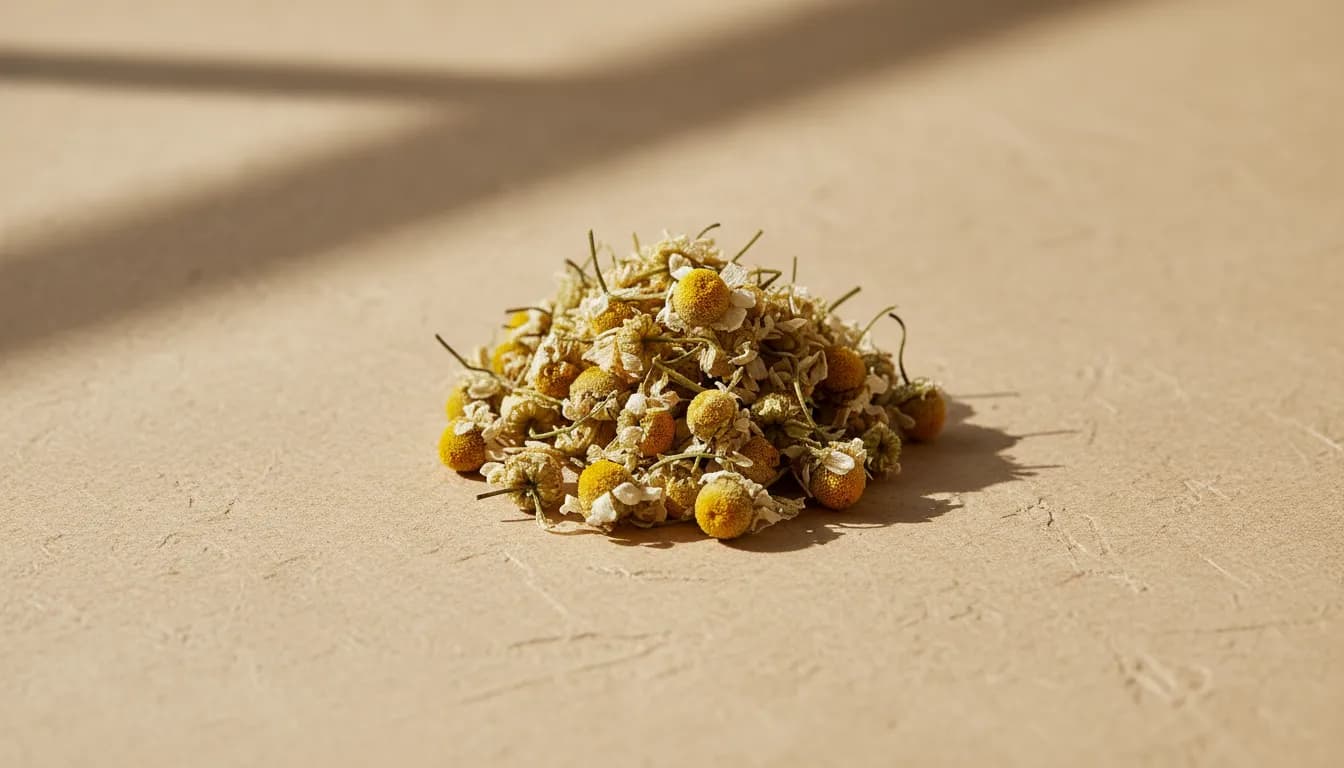
Chamomile flowers here are the dried flower heads of Matricaria chamomilla, German chamomile, one of two plants that share the name: the perennial Roman chamomile, Chamaemelum nobile, is a different genus grown mostly for its oil rather than for tea. The library uses German chamomile in twelve recipes, dried in every one: eleven teas and a single batch of digestive gummies, where the brewed tea is set with agar and a dose of psyllium husk. The amount runs from half a gram in digestive mint tea to close to two grams in sweet digestive tea, and several pots, sweet digestive tea and Low Tide among them, add the flower only once the heat is off, so it steeps rather than simmers.
The two compounds this library tracks are alpha-bisabolol and apigenin, and neither is the blue people associate with chamomile oil: that colour, chamazulene, forms only in a still, breaking out of a colourless precursor called matricin under heat, and a cup of hot water is not a still. What steeps out instead is mostly water-soluble apigenin, and in the living flower it sits bound to a sugar as apigenin-7-glucoside; drying and brewing both shift the balance, so a cup carries more flavonoid glycosides and less free apigenin than the flower itself. Apigenin's fame rests on a 1995 laboratory result: isolated from chamomile and tested against a labelled benzodiazepine, it displaced the drug from brain receptors at a modest affinity of 4 micromolar, and mice given it acted less anxious without sedation. A year later another group fractionating the same flower found that GABA itself, which chamomile also contains, was the main agent doing the displacing, and nobody has measured how much free apigenin a single cup actually delivers to the blood.
What chamomile does once swallowed rests on trials that mostly did not use tea. A 2009 trial gave 57 people with generalised anxiety disorder a standardised capsule extract for eight weeks and found a modest improvement over placebo, at a p value of 0.047 the authors themselves called fragile; a 2016 follow-up randomised 93 responders to keep taking the extract or switch to placebo, and relapse ran 15 percent against 26, a gap that did not reach significance. Pooled across twelve trials, chamomile's effect on anxiety itself is null, but sleep quality holds up better; the one trial that actually used tea, in eighty postpartum women, found two weeks of it improved sleep and mood against routine care, though the gain had faded by four weeks. Europe's medicines regulator authorises chamomile flower only for minor gut complaints such as bloating and mild spasms, at 1.5 to 4 grams in 150 millilitres of boiling water, three to four times a day, which is close to what the digestive gummies are actually built on; sleep and anxiety aren't on that label. The one clear caution is the daisy family itself: chamomile pollen cross-reacts with ragweed and mugwort, and a documented anaphylaxis followed a child's first-ever cup.
CHEMISTRY
2The characteristic compounds documented in this ingredient, plus any the library traces to it in a recipe. Not an exhaustive phytochemistry.
USED IN
12Chamomile, Lavender & Star Anise
0.8 g · dried; ≈ 1 tsp
STEP 1 Combine the chamomile, lavender, and star anise in a warmed pot.
Chamomile, Butterfly Pea & Ginger
0.6 g · dried
STEP 2 Take off the heat, then add the chamomile and butterfly pea petals.
Deep Sleep Tea
1 g · dried
STEP 2 Turn off the heat and add the chamomile, lavender, valerian, and mint.
Sweet Digestive Tea
1.8 g · dried
STEP 2 Turn off the heat and add the chamomile and dried mint.
Gentle Gas Relief Tea
1.5 g · dried
STEP 2 Turn off the heat and add the chamomile, dried mint, and licorice.
Carminative Digestive Gummies
1.5 g · dried
STEP 1 Steep the tea, covered: bring the water to a bare simmer, add the cumin, fennel, aniseed, chamomile, and mint, cover tightly, and steep 12–15 minutes. Covering matters: the actives are volatile oils that steam off in an open pot.
Low Tide
1.6 g · dried
STEP 2 Take the pot off the heat entirely and wait about a minute for it to drop below a boil, then add the chamomile and rose buds and cover. Chamomile turns bitter and hay-like if it boils; rose loses its perfume outright.